Pacific Barreleye (Macropinna microstoma): The Fish That Looks Through Its Own Forehead
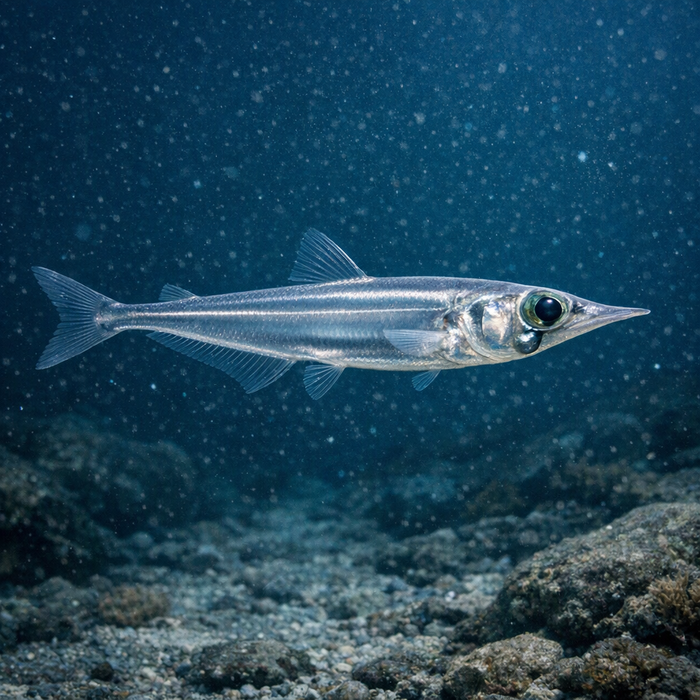
The Pacific Barreleye looks like somebody installed a viewing window where a fish’s forehead should be. That transparent dome is real, and the green structures inside are its eyes—not its brain, not decorative lights, and definitely not normal-looking fishing-trip material. This small saltwater predator belongs to the family Opisthoproctidae and inhabits deep ocean midwater. Its appeal is not brute strength or heavyweight proportions. It is the sheer audacity of its anatomy.
For anglers, the essential distinction comes early: this is not an established recreational target. There is no validated rig, bait program, or seasonal bite to unlock. Legendary difficulty does not mean you need a bigger reel. Here, it means the usual angling playbook does not exist.
What Makes the Pacific Barreleye Unique?
The headline adaptation is a transparent, fluid-filled shield surrounding the upper head. Beneath it sit tubular eyes with vivid green lenses. The dark spots above the mouth, which look conveniently positioned to be eyes, are actually olfactory organs. Its face is effectively a practical joke on anyone identifying fish by first impressions.
Those unusual eyes also move. They can look upward through the transparent shield, then rotate forward during feeding. That solves a genuine mechanical problem: spotting something overhead is useful, but eventually the mouth needs to meet the meal. Researchers once believed the eyes remained fixed upward; observations of living fish changed that understanding.
The third standout is control. Broad, flat fins help this compact fish hover almost motionless and maneuver precisely. Among Pacific Barreleye facts, that combination of strange optics and careful positioning matters more than the novelty photograph suggests. The weirdness has a job.
Habitat & Global Range
Pacific Barreleye habitat is deep, open-ocean midwater in the North Pacific. Its documented range extends from the Bering Sea toward Japan and south along the eastern Pacific to Baja California. Central California observations commonly place living fish around 600–800 meters, approximately 2,000–2,600 feet beneath the surface. Treat that as a well-documented observation band, not an absolute boundary for every individual.
This is water-column habitat, not a reef, kelp bed, or bottom ledge fishery. The important setting is the dim mesopelagic environment and the organisms suspended within it. A coastline appearing inside the species’ range does not make nearby piers productive places to target it. Geographic presence and recreational accessibility are very different things.
Behavior & Temperament
The Pacific Barreleye is associated with a quiet, solitary existence rather than visible feeding frenzies. Underwater observations show fish holding position with the body horizontal and the eyes directed upward. They can change orientation as they feed, keeping visual attention on food while bringing the mouth into position.
Calling that behavior patient is reasonable shorthand; calling it aggressive, territorial, or a hard fighter would outrun the evidence. There is no established recreational account of its strike or fight to translate into tackle advice. Its slow-looking movements on research footage also do not establish what a hooked fish would do. Watching an animal and fighting one are not interchangeable datasets.
Ecological Importance
The Pacific Barreleye participates in the midwater food web as a predator of small drifting animals. Documented stomach contents include gelatinous remains, while its anatomy supports a diet involving both gelatinous and crustacean prey. Researchers have proposed that it sometimes takes organisms caught in siphonophore tentacles. That proposed food-stealing strategy is fascinating, but it should remain labeled a hypothesis rather than a settled routine.
Its broader importance is also educational. An intact living fish revealed features that damaged specimens had obscured. That is a useful reminder that collecting an animal does not automatically reveal how it lives. Sometimes the ocean needs to remain part of the experiment.
Conservation & Environmental Pressures
The Pacific Barreleye is listed as Not Evaluated, matching the absence of a completed global extinction-risk assessment in the reference information checked for this guide. That does not mean secure, threatened, or recovering. It means the assessment label cannot answer those questions. Population size, trends, and species-specific exposure to environmental pressures remain insufficiently resolved here.
Deep water should not be mistaken for isolation from human activity. Material entering the ocean can reach deeper environments, but assigning this species a measured pollution burden or climate-driven decline would require evidence not established for this profile. Likewise, uncommon research encounters are not a reliable population census. Protecting habitat and improving observations are more defensible priorities than inventing a dramatic conservation story.
The FishyAF Take
The Pacific Barreleye earns its place in an exotic species guide without pretending to be a conventional trophy. The spectacle is a tiny predator with extraordinary visual machinery, not a dockside weight slip. An impressive species does not owe us a sport fishery.
So leave the imaginary deep-drop recipe alone. No proven technique means no proven technique—not an invitation to dress speculation in expensive braid. Enjoy the footage, learn the anatomy, and recognize the difference between a fish worth understanding and a fish worth deliberately pursuing. Sometimes the sharpest angling judgment is knowing when the rod is beside the point.