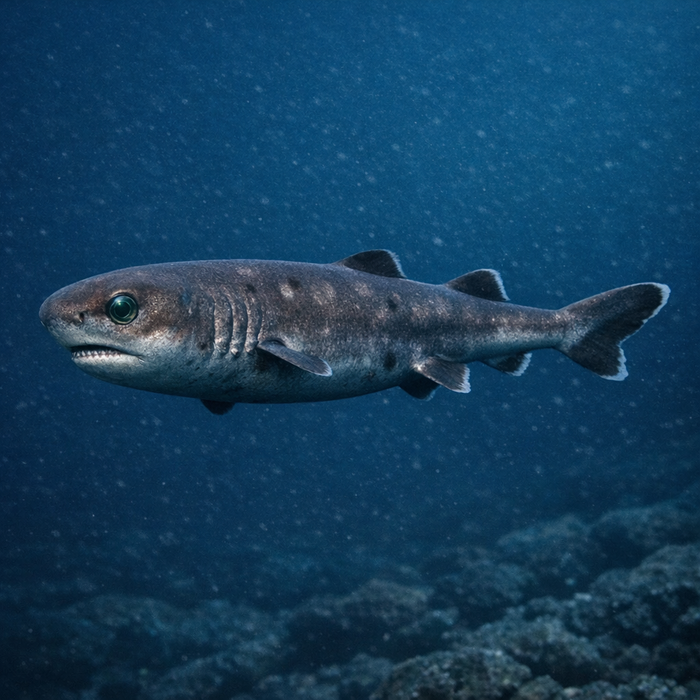
Cookiecutter Shark (Isistius brasiliensis): Small Shark, Surgical Bite, Absolutely No Respect for Size
The Cookiecutter Shark does not need to swallow a giant to make a meal of one. It removes a plug of flesh, leaves a crater, and gets on with its evening. Whales, tuna, and other sharks can carry the evidence. This is a predator whose signature often gets noticed before the animal itself. Small does not mean polite.
Belonging to the family Dalatiidae, this compact saltwater shark occupies open-ocean and deep-sea habitats rather than the familiar reef-and-beach circuit. For anglers, that distinction matters: it is a fascinating species, not a validated recreational target with a dependable tackle recipe. A remarkable mouth does not automatically make a practical fishery.
What Makes the Cookiecutter Shark Unique?
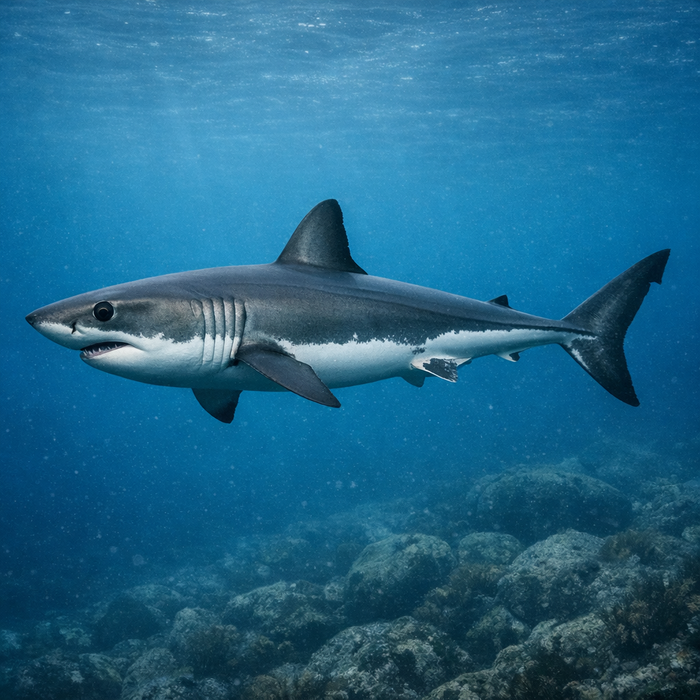
The business end combines suction with cutting machinery. Thick lips and a modified throat help the shark attach to a larger animal. Small upper teeth grip, while much larger lower teeth form the cutting edge. A twisting movement removes a roughly circular, conical piece of flesh. The resulting wound explains the name far better than any marketing department could.
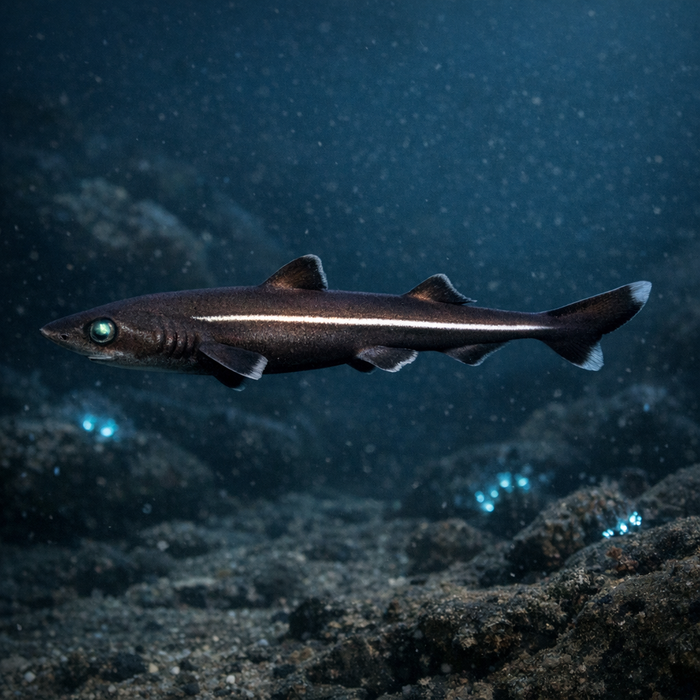
Then there is the lighting. Tiny organs called photophores produce a greenish glow along the underside, interrupted by a dark collar near the gills. Researchers have proposed that this collar resembles a small prey silhouette against the glowing body, but that lure explanation remains a hypothesis. Cookiecutter Shark facts get weird enough without upgrading an intriguing theory into settled science.
Its teeth provide another excellent reason to keep your fingers elsewhere. The lower set is replaced together, and shed lower teeth can be swallowed. The suggested explanation involves recovering material needed for its substantial dentition, but the nutritional purpose is not established. The documented behavior is strange enough on its own: this shark can eat its own discarded cutting equipment.
Habitat & Global Range
Cookiecutter Shark habitat spans the Atlantic, Indian, and Pacific oceans, especially tropical and temperate oceanic waters. Records include waters around Hawaii, Japan, Australia, Brazil, and several remote oceanic islands. Its distribution is widespread but patchy. A global range does not mean an angler can point at any offshore chart and reasonably expect to find one.
The important movement is vertical. The species is reported from deep water during daylight and nearer the surface at night. That connects its deep-sea identity with encounters involving animals that use shallower ocean layers. It belongs in the water column, not in a tidy category of bottom fish living beside one particular reef, wreck, or ledge.
Behavior & Temperament
The Cookiecutter Shark is often described as a facultative ectoparasite: it can feed on part of a larger living animal without consuming the whole animal. However, flesh plugs are not its entire menu. It also consumes smaller prey whole. Thinking of it only as a miniature shark that robs whales misses a substantial part of its feeding ecology.
A Central Pacific study using several dietary tracers suggested that smaller prey were more important than the familiar photographs of wounded giants imply. That finding should not be stretched into a universal dietary percentage for every population. It does make one useful point: visible bite marks tell us who was bitten, not necessarily everything the shark ate.
Its small size is no invitation to handle it casually. Captured individuals can be active and can bite, and human bites have been documented. Those facts deserve respect without turning an unusual oceanic shark into a beachside horror story. For anglers, the sensible response is distance from the mouth, restrained handling, and no unnecessary contact.
Ecological Importance
The Cookiecutter Shark connects deep-water feeding opportunities with larger oceanic animals. Its unusual strategy allows it to exploit prey far beyond anything it could swallow. Rather than judging the animal by the inconvenience of a wound, consider the specialization involved: it has evolved a way to obtain food from an enormous moving resource without needing an enormous body.
Those distinctive wounds also give researchers indirect evidence of encounters that would otherwise be difficult to observe. A scar is not a complete tracking record, and every round mark should not be treated as a perfect species identification. Still, studying bite patterns can help investigate relationships between these elusive sharks and other pelagic animals.
Conservation & Environmental Pressures
The species is assessed as Least Concern. Australian fisheries reporting describes occasional captures in pelagic longlines and some net fisheries, rather than a substantial directed fishery. That relatively limited capture exposure is encouraging, but population size, structure, and trends remain poorly known. A reassuring assessment and a complete understanding of abundance are not the same thing.
The FishyAF Take
The Cookiecutter Shark is a reminder that fishing knowledge includes knowing when not to sell a fantasy. There is no verified recreational playbook here, no honest promise of a productive destination, and no reason to dress incidental capture up as a proven technique.
Admire the engineering. Respect the teeth. Skip the invented trophy talk. This shark does not need a heavy-tackle legend to earn its place in the guide; its actual biology is considerably stranger than the story anyone needs to manufacture.