Giant Frogfish (Antennarius commerson): The Reef’s Best-Disguised Angler Already Has Its Own Rod
Some fish chase dinner. This one convinces dinner to investigate a suspicious lump. The Giant Frogfish is a deep-bodied saltwater predator with the outline of a sponge, the patience of a parked truck, and a fishing lure growing from its head. Belonging to the frogfish family Antennariidae, it turns camouflage into an offensive weapon. That ridiculous appearance is not an evolutionary accident. It is working equipment, built for ambushing prey at close range. For anglers, the important distinction comes immediately: this is an extraordinary reef fish, not an established recreational target. Admiring its technique makes considerably more sense than trying to sell it a bait.
What Makes the Giant Frogfish Unique?
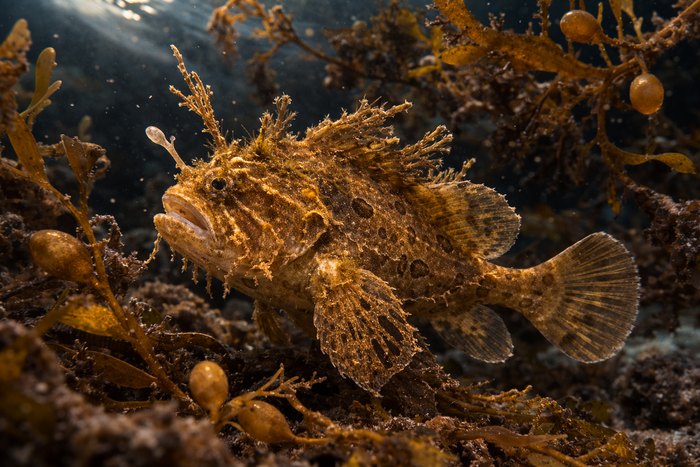
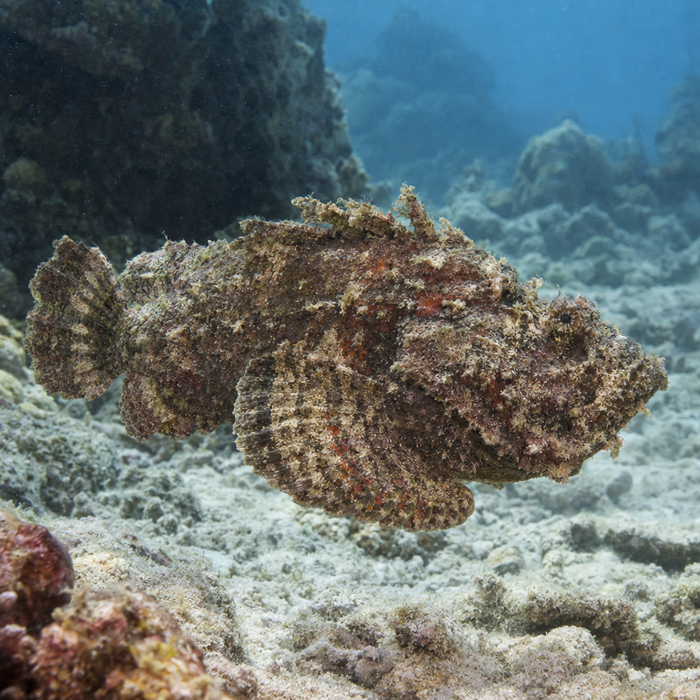
Three features deserve the spotlight. First, its foremost dorsal spine has become a movable fishing rod, tipped with a fleshy lure. Instead of searching the reef for every meal, the fish can advertise a tempting distraction directly above its mouth. Second, its variable coloration and irregular body surface help disguise it among reef growth. Yellow, brown, red, black, and other color forms can belong to the same species; color alone is a poor identification shortcut. Third, its pectoral fins have an elbow-like joint, giving this apparently shapeless animal surprisingly useful supports.
The Giant Frogfish also uses its fins to move along the bottom. It looks less like a conventional swimming fish than something making a reluctant walk across the furniture. Among Giant Frogfish facts, that combination of built-in tackle, camouflage, and bottom-walking anatomy is the real headline. Nothing about the design suggests elegance. Everything suggests a fish that knows exactly where the next meal needs to stand.
Habitat & Global Range
Giant Frogfish habitat centers on shallow coral and rocky reefs, although the species is not confined to the first few meters. Its broad distribution covers tropical and subtropical Indo-Pacific waters, including the Red Sea, eastern Africa, Indonesia, Australia, and Pacific islands, with records extending into the eastern Pacific. Reef structure matters more than an empty stretch of bottom: look at the setting as a collection of potential disguises, not simply a depth contour.
The FishyAF location list includes Lembeh Strait, Ambon Bay, Bali sites, and Western Australia’s Houtman Abrolhos reefs. Treat those as encounter locations, not proven rod-and-reel fisheries. A place famous for unusual reef animals does not automatically come with a productive fishing method. Local observations can help establish whether a fish is currently present, but no location should be read as a guaranteed catch or even a guaranteed sighting.
Behavior & Temperament
The Giant Frogfish is an ambush specialist, not a reef patrol officer. It waits, blends in, and may move its lure to bring prey closer. When an animal enters striking range, rapid mouth expansion draws water and prey inward. Its apparent inactivity therefore tells you very little about its readiness to feed. The business end is already pointed in the right direction.
Do not confuse a motionless fish with one that needs prompting. There is no reason to poke it, reposition it, or wave food in its face for a better encounter. Watch from a respectful distance and let the behavior happen on its own schedule. Its camouflage is much more interesting when the animal is choosing the presentation rather than being managed like a photo prop.
Ecological Importance
As a predator, this fish participates in the reef food web by consuming animals that come within reach. Its hunting strategy illustrates how reef complexity supports more than shelter: uneven surfaces and living growth can also provide the setting for a remarkably convincing ambush. That does not justify claiming it single-handedly balances fish populations. Its ecological role is interesting enough without promoting it to reef management.
Reproduction adds a different kind of movement. Eggs are carried in a floating gelatinous mass rather than guarded in a bottom nest. That contrast is worth remembering: the adult’s bottom-associated lifestyle does not mean every life stage stays attached to the same patch of reef.
Conservation & Environmental Pressures
The species is assessed as Least Concern. That classification is not a promise that every local reef population is secure, nor does it authorize collection. Reef environments face warming, pollution, sedimentation, and physical damage, pressures that can alter the habitat supporting their fish communities. Those are habitat-level concerns, not evidence of a quantified global decline specifically attributed to this species. Keeping that distinction clear matters.
The FishyAF Take
The Giant Frogfish is what happens when the reef builds its own angler and gives it absolutely no interest in your tackle collection. Respect that. The advanced challenge here is recognizing the fish, understanding the disguise, and resisting the urge to turn every remarkable animal into a catch. Bring curiosity rather than a species-specific shopping list. A fish already fishing with its own forehead has earned the right to be left on the reef.