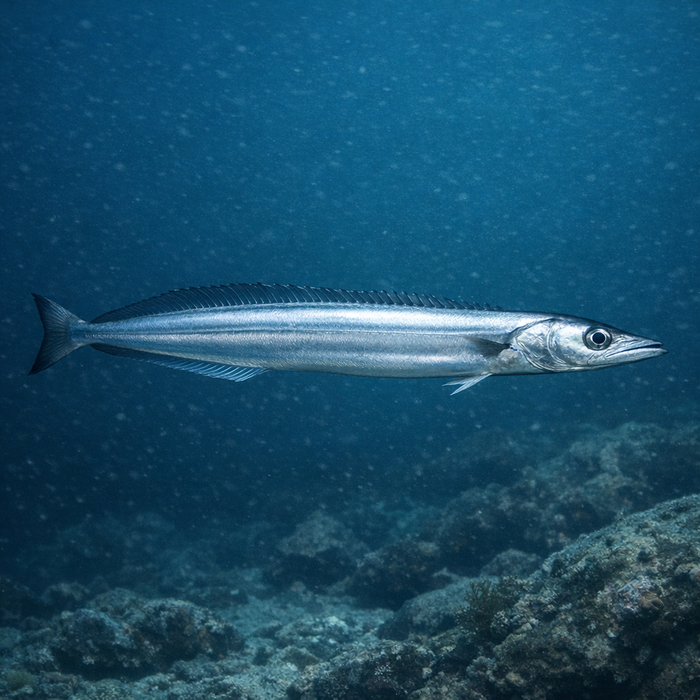
Stoplight Loosejaw (Malacosteus niger): The Deep-Sea Predator With a Private Red Searchlight
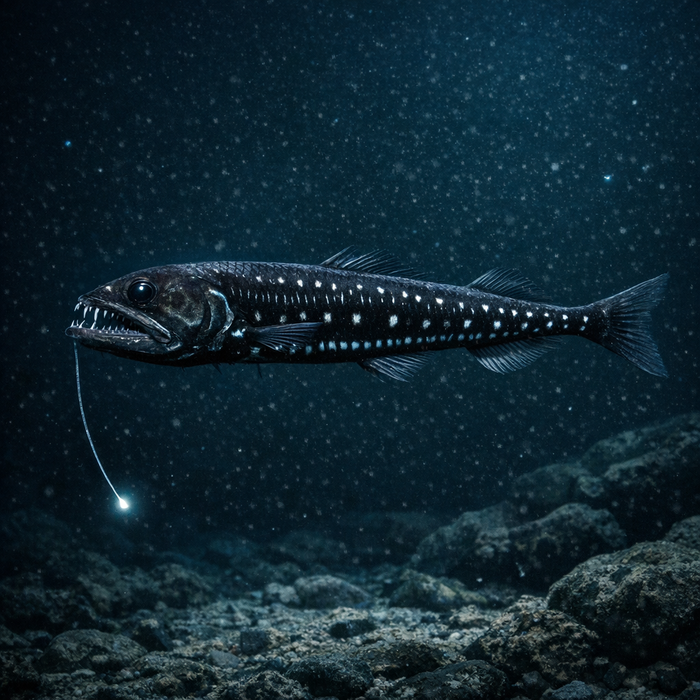
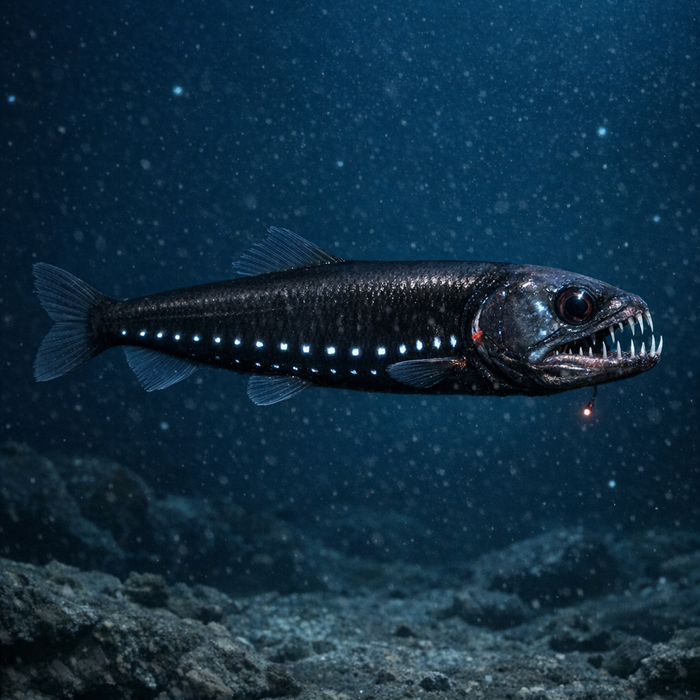
The Stoplight Loosejaw looks like somebody built a fish around a set of fangs and forgot to finish the mouth. Then evolution supplied something stranger: a red light system that helps it see what many neighboring animals cannot. This elongated saltwater dragonfish belongs to the family Stomiidae, and its remarkable visual equipment has made it a subject of deep-sea research.
For anglers, the important distinction comes immediately. This is not an obscure gamefish waiting for the right charter captain. There is no established recreational fishery, validated bait selection, or dependable rod-and-reel technique. Its appeal is biological, not a promise of bent rods.
What Makes the Stoplight Loosejaw Unique?
Start with the lighting. The Stoplight Loosejaw produces far-red bioluminescence from an organ beneath the eye, alongside shorter-wavelength light from another organ. Many deep-sea animals have visual systems poorly suited to detecting that red illumination. The result is something resembling a private searchlight, although calling it invisible to every other animal would oversell the trick.
Seeing that light requires an equally unusual adaptation. Its retina contains a bacteriochlorophyll-derived photosensitizer that enhances sensitivity to long wavelengths. This is not photosynthesis, and the fish does not run on sunlight. Researchers have investigated a dietary origin for the pigment, but its route into the eye remains incompletely understood.
Then there is the jaw. The normal membrane forming the floor between the lower jaws is absent, leaving an extraordinary open framework armed with large teeth. An enormous gape and missing gill rakers complete a feeding apparatus that looks designed for substantial prey. Looks, however, are only half the story.
Habitat & Global Range
Stoplight Loosejaw habitat is deep ocean midwater, not the seabed. Published accounts place it in mesopelagic and bathypelagic waters, with reported depths extending from about 500 to 3,886 meters. Think open water far below ordinary recreational access, rather than a reef, wreck, or bottom contour that can be worked with a baited rig.
Its distribution spans the Atlantic, Pacific, and Indian oceans. Global does not mean present everywhere: the species is reported from high northern latitudes southward to roughly 30 degrees south, and is not known from the Mediterranean. Identification matters because a related southern species, Malacosteus australis, was formally distinguished in 2007. Older loosejaw accounts can blur those boundaries.
Behavior & Temperament
The Stoplight Loosejaw delivers a useful lesson in judging fish by their teeth. Despite its formidable mouth, examined specimens frequently contained large calanoid copepods. In samples from several ocean regions, these small crustaceans dominated prey numbers, although larger prey could contribute substantially to the biomass consumed. It is a predator, but not simply a miniature fish-eating monster.
Evidence also suggests it does not undertake substantial daily vertical migration into shallower water, generally remaining below 500 meters. That undercuts the tempting assumption that darkness brings it within reach. Descriptions of hunting mechanics deserve restraint, too: dramatic anatomy and stomach contents reveal adaptations and meals, not a complete behavioral script.
Ecological Importance
Among the most revealing Stoplight Loosejaw facts is the mismatch between its appearance and its feeding ecology. A fang-heavy dragonfish consuming numerous copepods connects small planktonic prey with a specialized deep-water predator. Its diet demonstrates that familiar categories such as planktivore and large-prey hunter need not describe mutually exclusive lifestyles.
Its visual system adds another layer. Light production, light detection, and food acquisition are intertwined in ways researchers are still resolving. The proposed connection between prey and retinal pigment is especially intriguing, but should remain a hypothesis rather than a tidy claim that every copepod meal automatically recharges its eyes. The uncertainty makes the biology more interesting, not less.
Conservation & Environmental Pressures
The Stoplight Loosejaw is listed as Least Concern. That is a conservation assessment, not a declaration that every population has been counted or every environmental vulnerability has been tested. Its lack of fisheries interest also distinguishes it from deep-water species deliberately harvested for food.
Responsible coverage should not manufacture a species-specific crisis from broader concerns about the deep ocean. Equally, distance from shore should not be treated as proof of immunity. The useful approach is to separate documented status from unanswered questions, avoid unsupported population claims, and recognize the value of continued biological sampling. A strange-looking fish deserves evidence, not a convenient doom narrative.
The FishyAF Take
This fish earns its reputation without needing an invented fight story. Red illumination, chemically assisted vision, and a mouth with the floor missing are already plenty. It does not need claims about crushing tackle or ambushing somebody's squid bait.
The right angler response is curiosity with a working bullshit detector. Appreciate the adaptations. Question any supposedly foolproof catching method. Keep recreational tackle advice out of a species account that cannot support it. Not every remarkable predator belongs on a fishing bucket list, and that is fine. Some fish make the ocean more compelling precisely because they remain outside our usual game. The Stoplight Loosejaw is one of them.