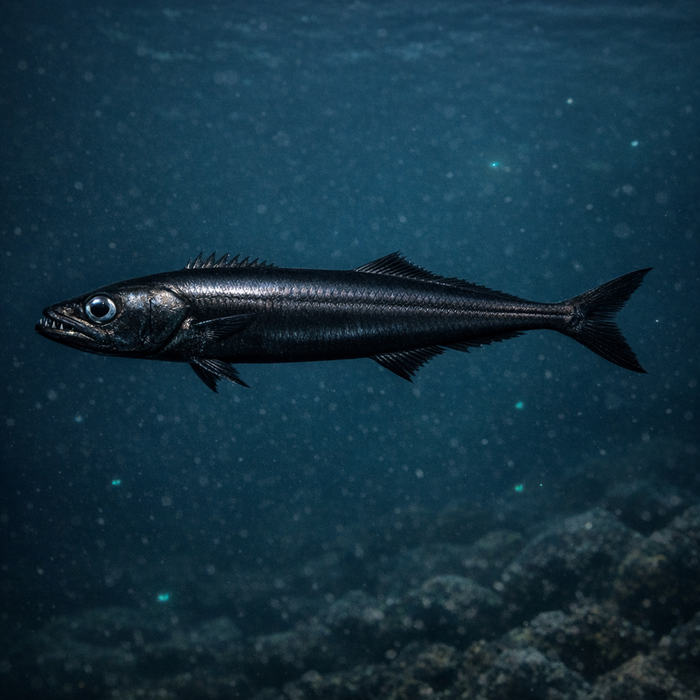
Pacific Viperfish (Chauliodus macouni): Fangs Past Its Eyes, Lights Under Its Belly
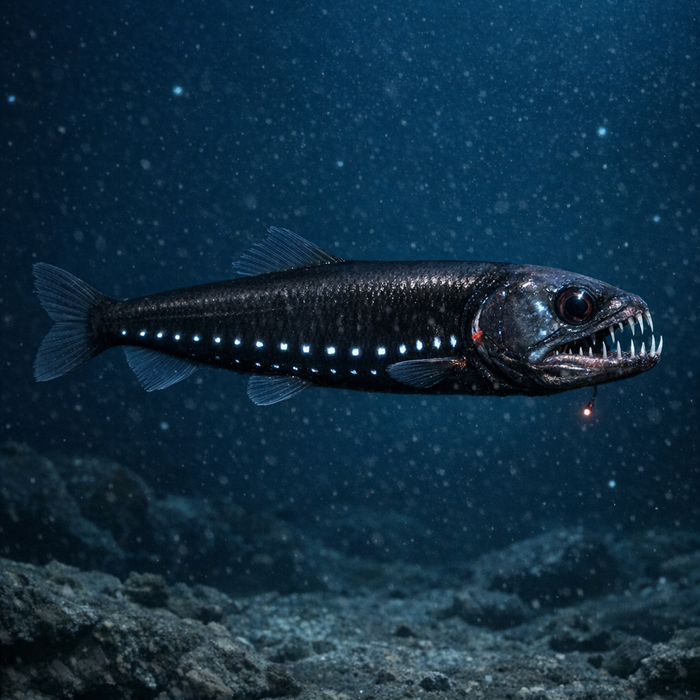
The Pacific Viperfish looks like somebody gave a small fish far too much dental equipment. Its lower-jaw fangs reach past its eyes, and its mouth turns captured prey into prisoners rather than giving them another chance. This elongated saltwater predator belongs to the dragonfish family, Stomiidae, and lives in the deep, open North Pacific. It is not a conventional sport fish, despite having a face that deserves its own warning label. The attraction here is understanding an extraordinary predator, not pretending there is a proven rig waiting to bring one over the rail.
What Makes the Pacific Viperfish Unique?
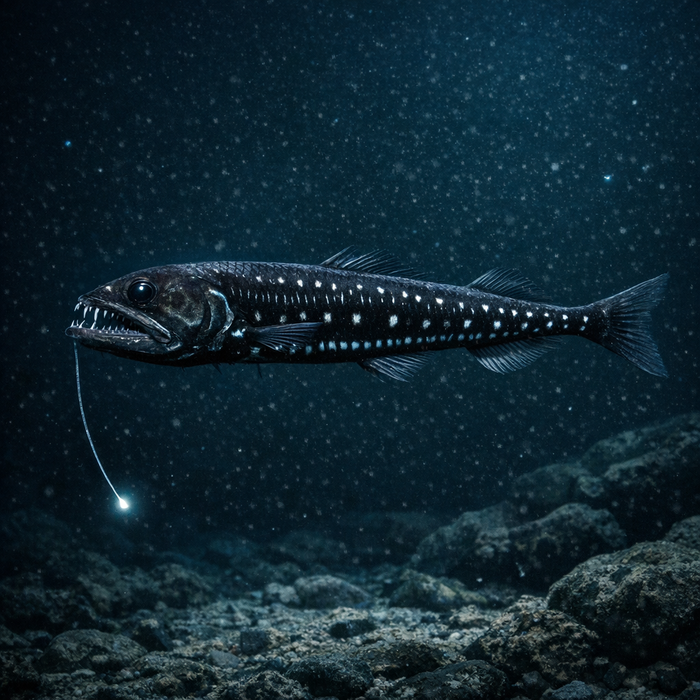
Start with the teeth. Those enormous front fangs project beyond the closed mouth, while the jaws open widely to engulf prey. The teeth then form a cage that helps prevent escape during swallowing. This is less about chewing dinner than making absolutely sure dinner stays put.
Next comes the lighting. Light-producing organs called photophores along the belly support counterillumination: producing light that helps blend the fish into the background when viewed from below. In the deep ocean, glowing can be camouflage rather than advertising.
Its camouflage has another layer. Exceptionally dark skin occurs above and below a mirrored stripe along the body. Measurements from dark patches reflected less than 0.6 percent of blue light at the tested wavelength. Among Pacific Viperfish facts, that combination of reflection, darkness, and living light is considerably more impressive than simply calling it scary.
Habitat & Global Range
Pacific Viperfish habitat is primarily the midwater of the North Pacific, including waters off Japan, the Bering Sea and Alaska, and the eastern Pacific south to Baja California and the Gulf of California. A commonly cited depth range is about 200–1,500 meters, spanning the twilight and midnight zones. Think water suspended above deep ocean terrain, not a fish permanently parked on a reef.
The guide identifies Monterey Bay, Davidson Seamount, Sur Ridge, Navarin Canyon, and the Santa Barbara Channel as relevant deep-water locations. These should not be read as established recreational fisheries for this species. A place can be excellent for deep-sea research without being a sensible destination for a baited hook. Distribution tells you where the animal belongs; it does not promise an angling opportunity.
Behavior & Temperament
The Pacific Viperfish participates in nightly upward migration, moving toward shallower waters to feed. That movement is biologically important, but it does not turn the species into a reliable nighttime surface target. Upward is a direction, not a guarantee of accessibility.
Its recorded food includes small fishes, crustaceans, and arrow worms. Feeding evidence also shows that diet descriptions depend on where and how animals are studied: one Gulf of Alaska survey found fish dominated the stomach contents examined. Avoid reducing its behavior to an internet monster story. The useful picture is a small predator with effective prey-retention equipment, operating in an environment that anglers rarely observe directly.
Ecological Importance
The Pacific Viperfish occupies a feeding position within the deep pelagic food web, consuming smaller animals while also becoming food itself. Gulf of Alaska stomach analyses documented this species among the prey of another mesopelagic fish. Those spectacular teeth do not grant immunity from being somebody else's meal.
Its vertical movements also place it within the broader community connecting different ocean layers. Deep water is not an isolated basement full of unrelated oddities. Research observations reveal feeding relationships linking midwater animals with the larger ocean food web. For anglers, that is a useful reminder: the unseen water beneath a fishing boat contains a functioning ecosystem, not merely empty distance above the bottom.
Conservation & Environmental Pressures
The Pacific Viperfish is classified as Least Concern. Its assessment describes a widely distributed, deep-living species that is common and abundant in parts of its range, with no known major threats. Its population trend is unknown, however. Least Concern does not mean every population has been counted, every pressure measured, or every biological question answered.
The responsible conservation message is therefore measured rather than dramatic. Do not manufacture an endangered-monster narrative, but do not mistake limited information for complete certainty either. Research collections, underwater observations, and accurate identification remain important for understanding the species. For anglers, respecting collection rules and reporting an unusual encounter carefully are more useful than treating an unfamiliar deep-sea fish as an automatic trophy.
The FishyAF Take
The Pacific Viperfish earns its attitude honestly. It has the teeth, the camouflage, and the deep-water address. What it does not have is an established recreational technique, a verified bait recommendation, or a dependable fishing calendar in the species profile.
That distinction matters. Slapping an expert label on a species does not create a fishery, and an intimidating photograph is not a tackle test. Appreciate this animal for what it actually is: a compact predator equipped for a world most fishing gear never meaningfully samples. Sometimes the strongest species-guide advice is to leave the shopping list blank. The fish is exceptional enough without inventing a battle on the end of your line.