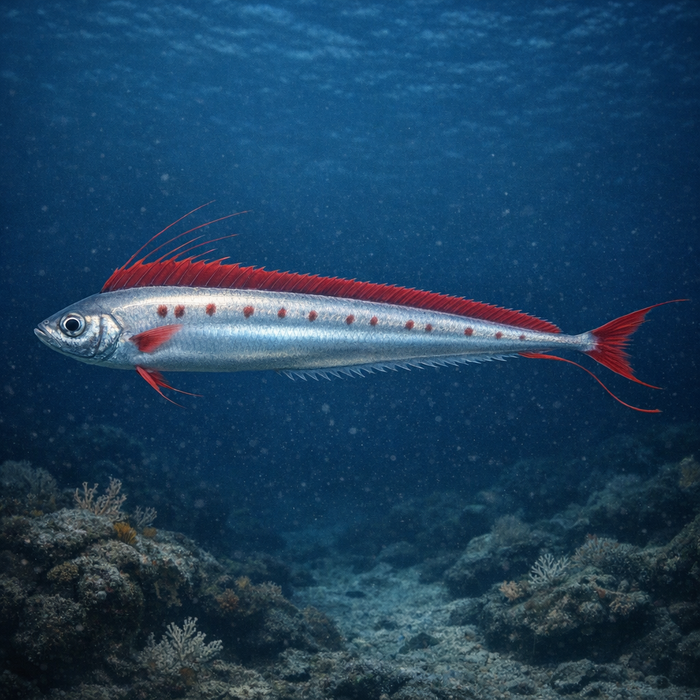
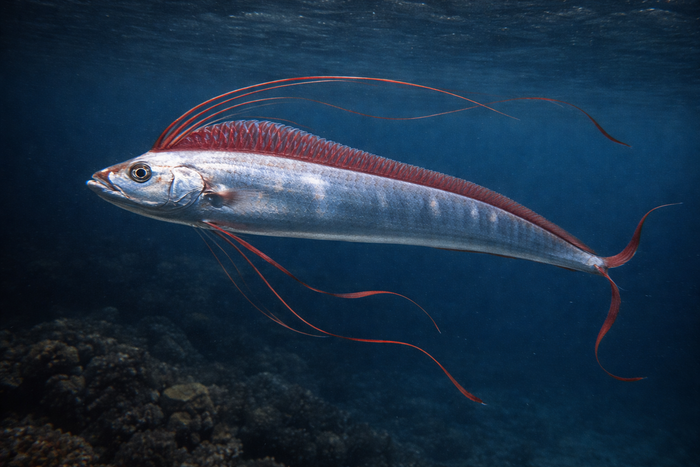
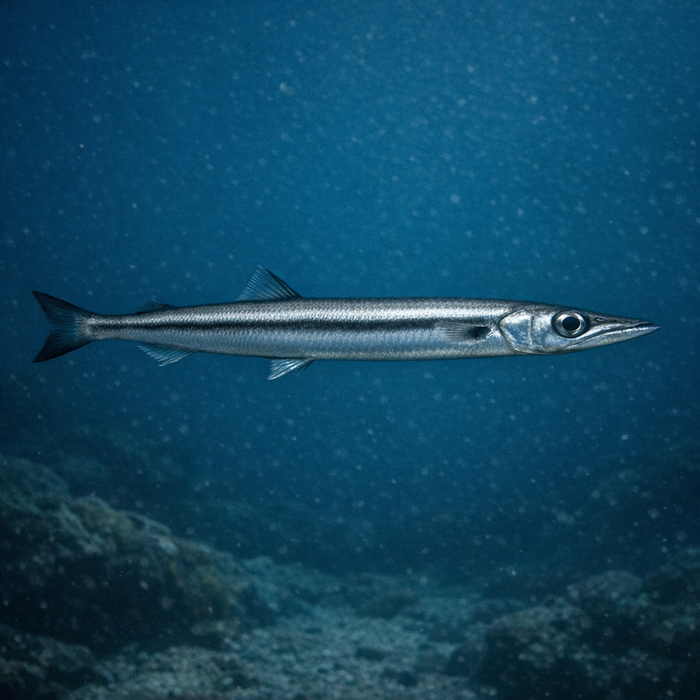
Whiptail Ribbonfish (Desmodema lorum): Silver Ribbon From The Midnight ZoneIntroductionMeet the ocean's minimalist sword: the whiptail ribbonfish. It's all blade, no bulk, and absolutely allergic to drama until the lights flip on at night. This long, paper-thin midwater drifter shows up where anglers least expect it and leaves before most even realize what they hooked. If you crave weird, delicate, and deep, the whiptail ribbonfish delivers the goods without the back-breaking fight.What Makes the Whiptail ribbonfish Unique?A few features make this fish instantly recognizable. First, the dorsal fin starts right above the eye and runs nearly the entire length, a racing stripe of fin rays powering gentle undulations. Second, each pelvic fin is reduced to a single long ray, often bright red, hanging like tassels-signature lampriform weirdness. Third, that namesake tail narrows into a threadlike whip, more streamer than fin. Combine mirror-silver skin that sheds guanine like glitter with huge low-light eyes, and you've got a midwater specialist engineered for dim blue space.Habitat & Global RangeConsider the whiptail ribbonfish a commuter of the open ocean midwater, usually offshore and away from structure. It likely rides the deep scattering layer, rising toward the surface at night and sliding back down by day. Storms, currents, and floating lights can shuffle the deck and bring them within reach. The species shows a wide tropical to subtropical distribution, popping up in bluewater off islands, seamounts, and continental edges around the world. If you're mapping Whiptail ribbonfish habitat for a trip, think open ocean drifts, deep contours, and night operations near light sources.Behavior & TemperamentThe whiptail ribbonfish is no brawler. Expect a cautious picker that mouths small offerings and leans on stealth. It's built for efficiency, not power, gliding through the water column with low-amplitude waves of that endless dorsal fin. Nights see more activity, especially near scattering layers and under deck or buoy lights that concentrate plankton and tiny bait. Hooked fish tend to twist and ribbon rather than sprint, and rough handling can cost you the threadlike tail or tear soft tissue.Ecological ImportanceThis species slots neatly into the midwater food web. It snacks on krill, larval fishes, and small squid, then feeds bigger pelagic hunters like tuna, billfish, and sharks. The whiptail ribbonfish moves energy from the plankton-rich twilight zone toward the surface where the heavy hitters roam. That up-and-down commute helps connect deep life with the bluewater action anglers care about.Conservation & Environmental PressuresThere's not much targeted effort for the whiptail ribbonfish, and commercial value is limited, which helps. But open-ocean ecosystems don't live in a vacuum. Climate-driven shifts in currents and water temperature can move scattering layers and change when-or if-these fish rise at night. Light pollution offshore and floating debris fields may also adjust behavior in ways we barely understand. Formal status listings are sparse, so don't assume abundance equals invincibility. Like a lot of midwater players, it's probably abundant someplace, invisible most places, and under-documented everywhere.The FishyAF TakeThe whiptail ribbonfish is a curveball, not a headliner. You don't plan a trip for it; it photobombs your tuna run or shows up when you're jigging under the lights. That's the charm. It's a silver ribbon with oddball tassel fins, a nighttime cameo from the midwater world. If you want a grip-and-grin bruiser, look elsewhere. If you want a fish that makes your crew say what is that, you're in the right neighborhood. File this page under Whiptail ribbonfish facts you wish you knew before that weird blue thing slid out of the dark. And if you're building a logbook of oddities, the whiptail ribbonfish earns a star just for style.