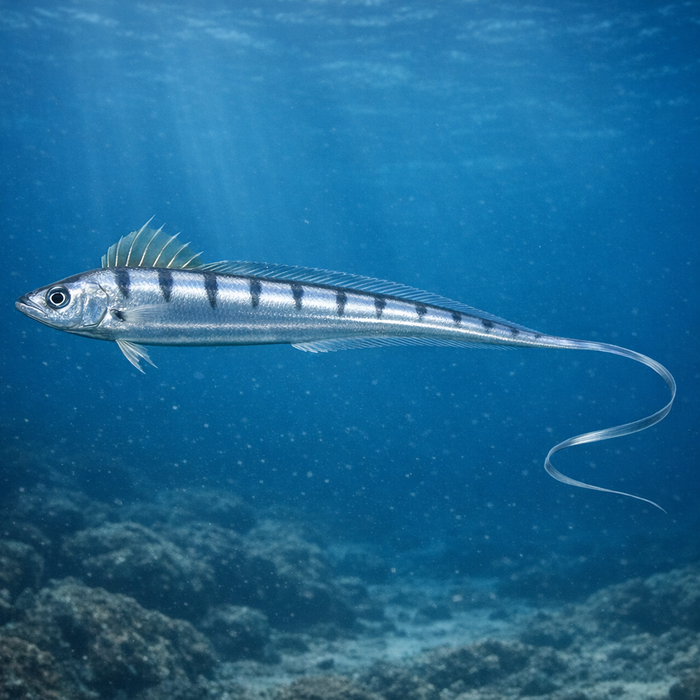
King-of-the-salmon (Trachipterus altivelis): A Bold, Memorable Hook LineIntroductionThe king-of-the-salmon is that surreal fish you see in storm-tossed photos and think, no way that's real. It is. Long, blade-thin, chrome-silver, with a crimson crest and two bright red pelvic "oars," this North Pacific ribbonfish looks like someone crossbred a sword and a streamer. You won't target it like tuna or halibut. You'll encounter it like a rumor that suddenly grew gills. But for anglers who love true oddities, few saltwater fish hit the weird-o-meter harder than the king-of-the-salmon.What Makes the King-of-the-salmon Unique?Start with the silhouette. Trachipterus altivelis is an elongated metal strip with a dorsal fin that begins right between the eyes and runs nearly the whole body. The pelvic fins are ridiculously long and bright red, waving like flags. That profile isn't for speed; it's for life in the dim midwater, where hovering and slow cruising beat sprinting. The king-of-the-salmon also carries serious cultural lore. Coastal peoples once crowned it the literal king of salmon, a fish you didn't mess with if you wanted a good salmon season. It's a great entry on any list of King-of-the-salmon facts-and yes, it absolutely has the headgear to match the title.Habitat & Global RangeWhen anglers ask about King-of-the-salmon habitat, the answer is midwater, offshore, and deep. This species haunts the mesopelagic band of the North Pacific, from Alaska and the West Coast to Japan. It rides currents along shelf breaks and submarine canyons, often hundreds of feet down. At night, it may rise with the vertical migration of squid and baitfish. Storms and unusual currents sometimes push individuals into coastal waters or even onto beaches. That's when social media lights up and local tackle shops become rumor mills.Behavior & TemperamentThe king-of-the-salmon isn't built to brawl. Expect a strange, sometimes passive fight if you hook one, more like landing a kitestring than a torpedo. In its own world, it's a stealth predator, using big eyes and a ribbon body to hover, drift, and ambush. It's solitary or loosely associated, not a pack hunter, and it often moves at night. Up close, the skin is scaleless and the tail is small, so near-surface swimming looks clumsy. Handle gently; their skin sloughs a silvery film and tears easily.Ecological ImportanceMidwater predators like the king-of-the-salmon connect deep food webs with surface life. They vacuum up small fish and squid below, then become meals for bigger offshore predators above. Stomachs from stranded individuals frequently show piles of squid beaks, a calling card for mesopelagic dining. In a way, they're translators-turning the deep's biomass into something the open ocean can use.Conservation & Environmental PressuresHard data on population status is thin. They're not a directed fishery species and most captures are one-offs, strandings, or bycatch. That makes trends tough to nail down. Still, the usual suspects apply: shifting currents, oxygen changes, and deep-ocean warming can shuffle midwater communities and alter where and when anglers ever see a king-of-the-salmon. Pollution and marine debris don't help a fish that rides boundary layers and drifts with the night life.The FishyAF TakeIf you catch one, you didn't beat the game. You glitched it, in the best way possible. The king-of-the-salmon is a living banner from the midwater realm, a fish that looks royal because it basically is, ruling the niche between surface chaos and abyssal quiet. Don't overthink the plan. Most anglers meet one while deep-dropping for something else or beachcombing after weather. If you're chasing oddities, keep squid strips ready and your camera hand steady. A clean length measurement and sharp photos might be worth more than fillets here. For pure fish-nerd glory, few species deliver a wilder story than the king-of-the-salmon.