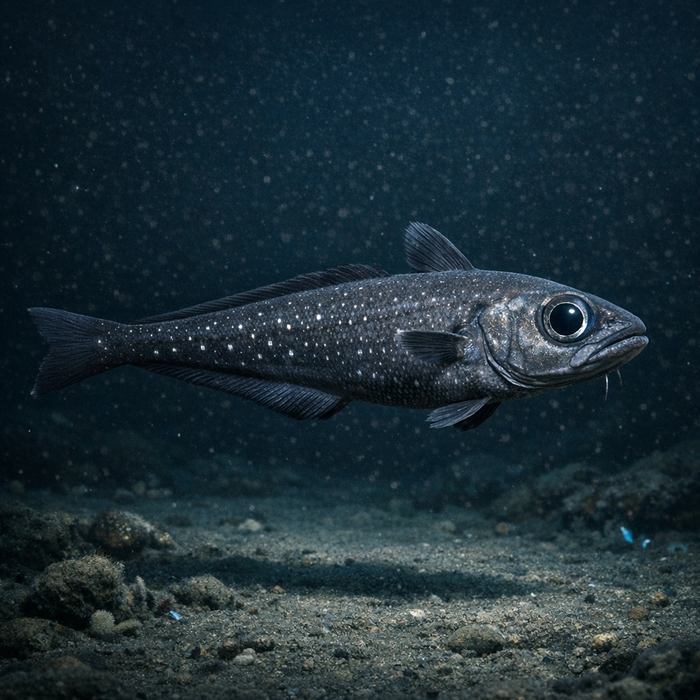
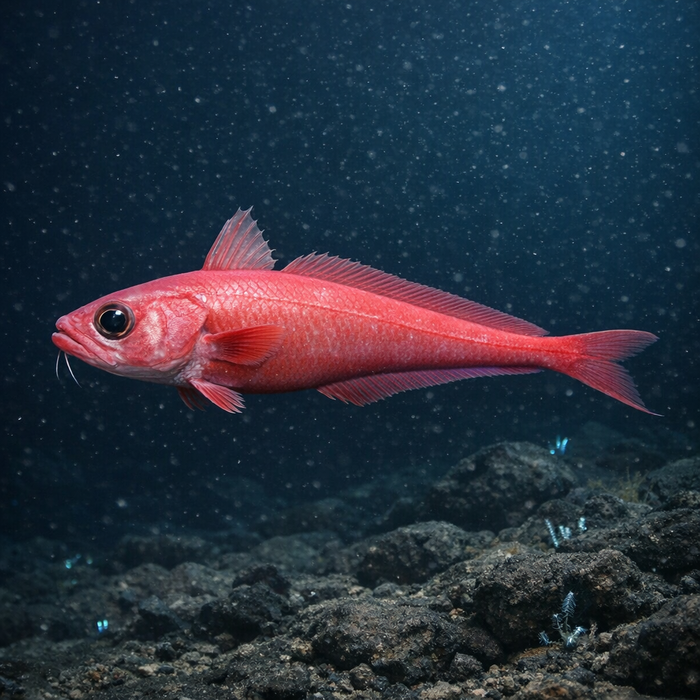
Tripod Fish (Bathypterois grallator): The Deep-Sea Predator That Brought Its Own Stilts
Most fish patrol their territory. The Tripod Fish parks above it. Supported by three extraordinarily long fin rays, this slender saltwater predator stands over the seabed and waits for food to arrive with the current. It looks like someone crossed a fish with surveying equipment, then abandoned the result in permanent darkness. The arrangement is real, and it works: specialized supports below, sensitive fins forward, and a mouth positioned for passing prey. This is not decorative weirdness. It is a remarkably specific solution to feeding near the deep-ocean floor.
What Makes the Tripod Fish Unique?
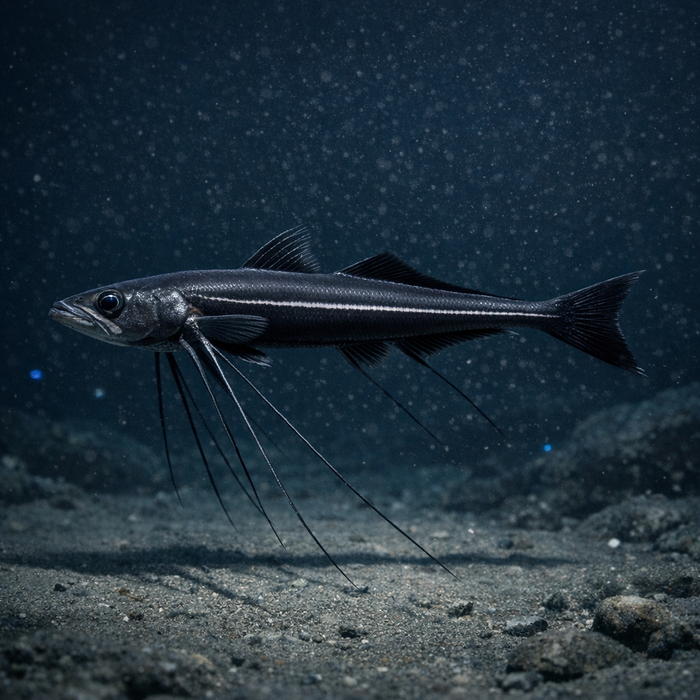
The defining feature is its three-point stance. Elongated rays from the two pelvic fins and the lower tail fin contact the bottom, holding the body clear of sediment. These supporting rays can exceed the fish’s standard body length, and specialized pads at their tips provide contact with the substrate. The supports are fins, not legs, even if the silhouette makes that distinction feel unnecessarily technical.
Its pectoral fins perform a different job. Held upright or forward while the fish is perched, they help detect nearby prey. Reduced eyes make vision a limited tool, so sensory information from the fins matters in this dark environment. Another standout trait is simultaneous hermaphroditism: an individual possesses male and female reproductive tissue at the same time. That does not justify every internet claim about its breeding. Having both reproductive functions is established; casually declaring routine self-fertilization goes beyond the evidence presented here.
Habitat & Global Range
Tripod Fish habitat belongs far below familiar fishing grounds. Published records place the species at approximately 878–4,720 meters, or about 2,880–15,490 feet. It occupies deep slopes, continental rises, oceanic ridges, and abyssal settings, often over sediment where its unusual stance is useful. This is bottom-associated saltwater habitat, not a shallow reef waiting for a cleverly presented bait.
Its distribution spans tropical and warm-temperate parts of the Atlantic, Indian, and Pacific oceans. Western Atlantic records include waters off the eastern United States and the Caribbean; scientific observations also document it near Hawaii. Global range does not mean it occurs everywhere, and a plotted occurrence is not a fishing recommendation. Encounters depend on suitable deep habitat and the equipment needed to observe it.
Behavior & Temperament
The Tripod Fish is generally solitary and famously sedentary. While perched, it faces into the current, allowing drifting prey to approach its feeding position. Its stillness should not be confused with inability to move. Submersible observations have recorded individuals swimming away when disturbed, and video has captured the transition from swimming to settling back onto the seabed.
During observed swimming, the pectoral fins extend sideways rather than maintaining their upright feeding posture. Landing involves a controlled rearrangement of the elongated supports. It is a fish with an actual parking procedure. None of this establishes a recreational fight profile: there is no validated basis for calling it a hard runner, stubborn bottom hugger, or delicate light-tackle catch. Watching it move and fighting it on a rod are entirely different kinds of evidence.
Ecological Importance
Among useful Tripod Fish facts, its feeding position is more important than its odd appearance. By standing above the bottom and facing the flow, it can intercept small swimming and planktonic crustaceans, including copepods. That makes it a predator operating at the boundary between the seabed and the water immediately above it. Its posture connects anatomy, local currents, and access to food in one distinctive package.
It also offers researchers a clear example of how life can specialize in deep habitats. Photographs alone reveal the stance, but repeated observations help distinguish feeding posture, swimming, and landing. The lesson is useful beyond this species: an animal that looks motionless in one frame may have behaviors that only become obvious when someone stays long enough to watch.
Conservation & Environmental Pressures
The Tripod Fish is classified as Least Concern. That status should not be translated into unlimited abundance, comprehensive population monitoring, or permission to collect it. A conservation category answers a different question from a fishing regulation, and deep-water species still come with substantial gaps in what researchers can observe directly.
Bottom-contact fishing can disturb seabed habitats, while debris and contaminants can reach deep environments. These are relevant habitat-level concerns, not proof of a measured worldwide decline in this particular species. Keeping that distinction intact matters. The deep sea is difficult to study, but uncertainty is not a license to invent either catastrophe or immunity.
The FishyAF Take
This fish deserves attention without a fabricated tackle recommendation. The supplied guide correctly treats rods, reels, baits, and recreational techniques as unestablished; fisheries documentation likewise provides no recreational catch figure. Turning that absence into a generic deep-drop shopping list would be nonsense with expensive line attached.
Respect the animal for what it actually does. It stands on modified fins, reads its surroundings through sensitive appendages, and lets the current bring opportunities within reach. Not every extraordinary species needs to become somebody’s next catch. Sometimes the most impressive fish in the room is the one that makes your entire tackle box irrelevant.