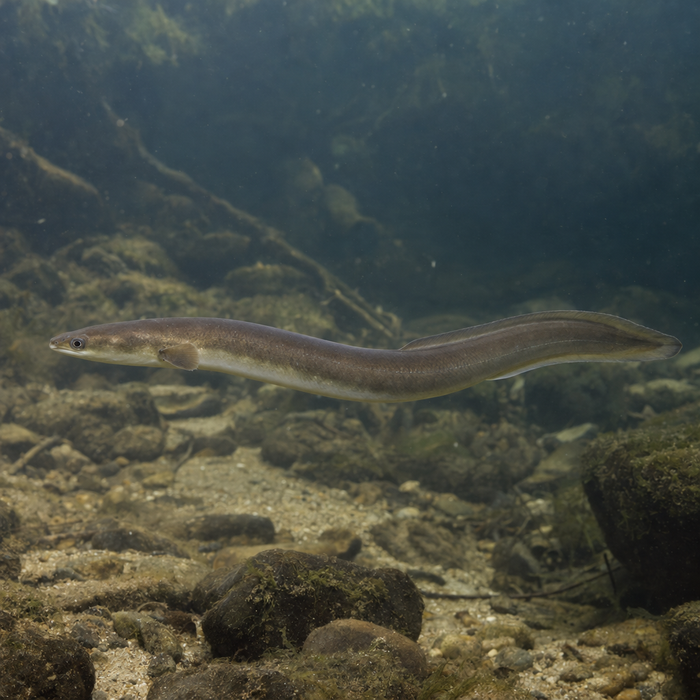
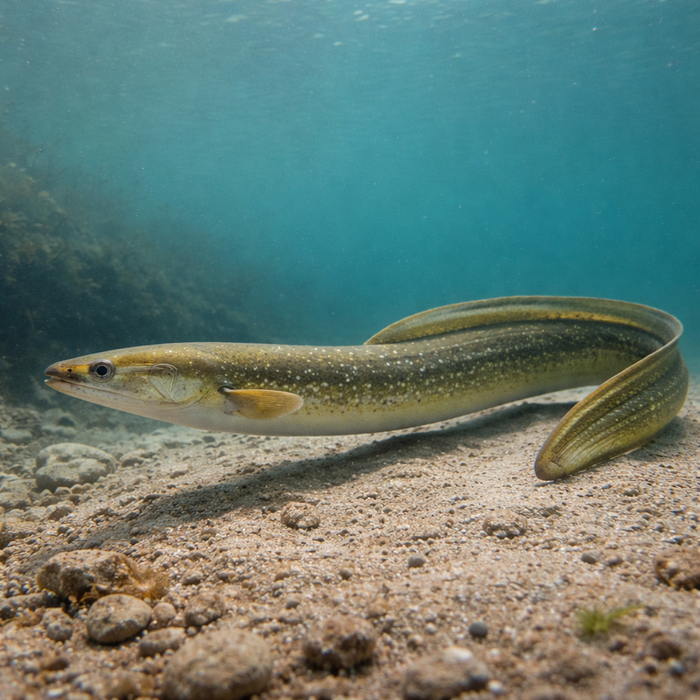
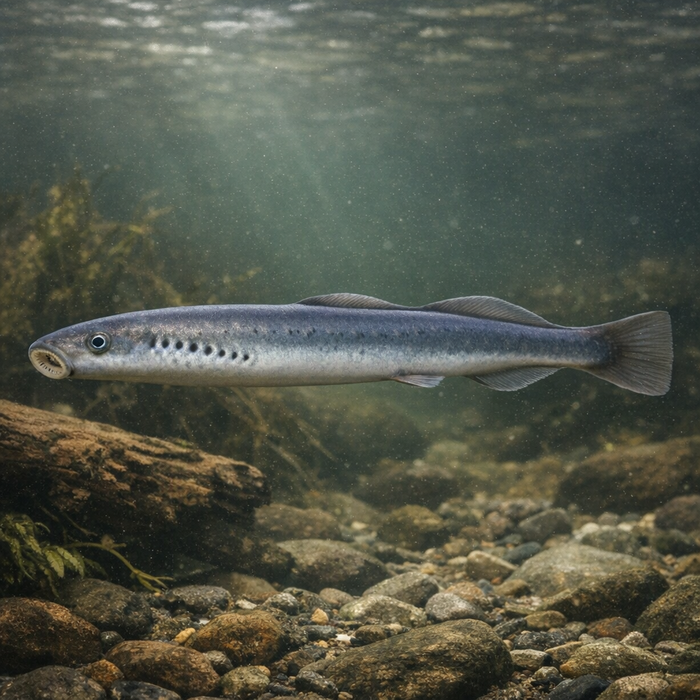
European Eel (Anguilla anguilla): The Nightshift Predator With an Atlantic-Sized Exit Plan
A European Eel on the line feels less like a conventional fish and more like a muscular argument. Long, slippery, and built to work around cover, it turns a quiet bottom-fishing session into something considerably less tidy. FishyAF’s typical angler benchmark is 22–28 inches and 1–2 pounds: enough fish to demand proper tackle without looking impressive on a ruler alone.
But its real credentials lie beyond the landing net. This freshwater-associated predator belongs to a life cycle linking European and North African waters with the open Atlantic. The fish under your rod tip has a much bigger itinerary than your next cast.
What Makes the European Eel Unique?
The European Eel reverses the migration pattern familiar from salmon: it grows in continental waters and heads out to sea to reproduce. Its breeding area lies in the Sargasso Sea, thousands of kilometres across the Atlantic. Satellite tracking published in 2022 directly demonstrated adults reaching that region, strengthening a conclusion originally built from surveys of tiny larvae. The exact business of wild spawning remains difficult to observe.
Its early life looks nothing like the fish anglers recognize. Transparent, leaf-shaped larvae become slender glass eels before pigmentation develops. Later, the yellow growth stage gives way to the silver migratory stage. Eyes enlarge, coloration changes, and feeding eventually stops as stored energy takes over. This is not merely a fresh paint job; it is a physiological rebuild for ocean travel.
Then there is its skin. Beneath that famously slippery surface sit tiny embedded scales, while the skin itself contributes to oxygen uptake. Among European Eel facts, that combination deserves more attention than another complaint about slime.
Habitat & Global Range
European Eel habitat includes rivers, streams, lakes, ponds, estuaries, and coastal waters across much of Europe and northern Africa. Freshwater is a useful angling category, not a complete description of the species. Some individuals spend their growth phase in brackish or marine environments rather than committing to an upstream freshwater life.
For anglers, cover matters more than a picturesque bank. Submerged roots, stones, vegetation, and soft-bottom refuges offer places to shelter. Feeding fish can move away from those resting areas, so the best-looking snag is not automatically the best place to put a hook. There is no universal productive depth: food, shelter, water conditions, and local movements all influence where eels turn up.
That flexibility has limits. A waterbody can look suitable yet be difficult to reach because a weir, dam, or other structure blocks access. Connected habitat matters as much as habitat quality.
Behavior & Temperament
The European Eel is primarily a night-active predator, although daytime feeding certainly happens. It eats a varied selection of invertebrates and fish rather than following one rigid menu. Chemical sensing is important, and experiments demonstrate sensitivity to several waterborne substances. Darkness does not leave this fish searching blindly.
At the bank, that means bait placement, prompt bite detection, and controlled handling deserve more attention than fancy presentation. Lobworms and fish strips fit the species well, but giving an eel a prolonged run creates an avoidable deep-hooking risk. Keep the connection between bait and indicator responsive. A missed bite is disappointing; a swallowed hook is worse.
Its slippery body is not an invitation to squeeze harder. Have the landing and release process ready before the first take.
Ecological Importance
The European Eel connects habitats that conservation discussions too often treat separately. Oceanic reproduction, coastal arrival, continental growth, and seaward departure are parts of one life cycle. Protecting a lake while ignoring its downstream route misses a substantial part of the picture.
During its growth phase, it participates in food webs as a predator of aquatic animals. During migration, it can become prey itself; tracking studies have documented predation on travelling eels. Being a capable hunter does not make the Atlantic a safe passage.
Conservation & Environmental Pressures
The European Eel is Critically Endangered. Its decline involves overlapping pressures, including fishing, illegal trade, migration barriers, habitat degradation, pollution, and parasites. No single explanation neatly accounts for the whole problem, and no single fix will repair the entire route.
The conservation response must therefore reach beyond individual catches. Eel passes can reopen upstream habitat, while safer downstream passage helps migrating adults avoid hazardous infrastructure. Reducing pollution and exploitation matters alongside restoring connections. For 2026, scientific fisheries advice recommends zero catches across all habitats, including recreational fisheries; that advice is distinct from the laws applicable at a particular venue.
The FishyAF Take
Calling this fish “rough” says more about fishing categories than the fish. It changes form, crosses environmental boundaries, and carries an ocean-scale future beneath an ordinary-looking riverbank. It deserves better than being treated as an awkward interruption to someone else’s target species.
Our take is straightforward: respect comes before pursuit. Where targeting is prohibited, leave it alone. Where catch-and-release remains permitted, legality is the starting point, not permission to fish carelessly. Use welfare-focused methods, keep handling brief, and consider choosing another target altogether. An impressive catch is not improved by an impressive amount of damage.