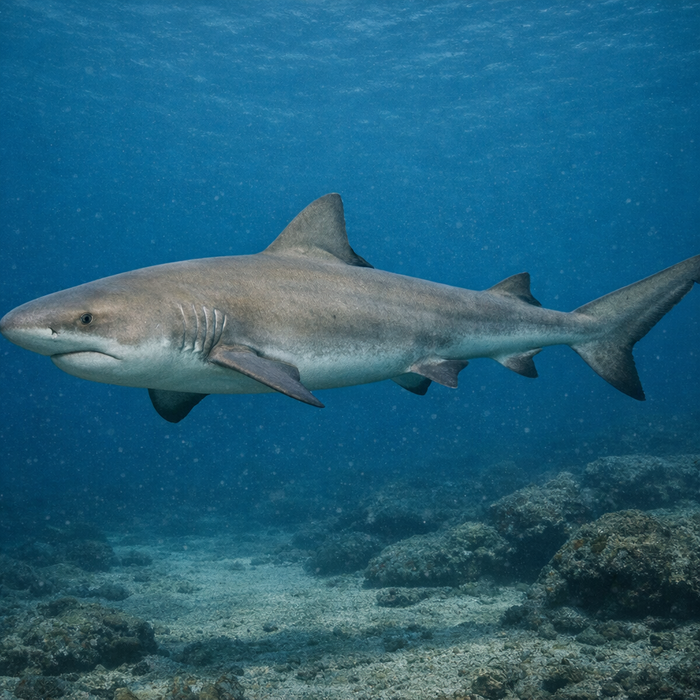
Frilled Shark (Chlamydoselachus anguineus): The Deep Sea’s Needle-Toothed Original
The Frilled Shark looks like somebody stretched a shark into an eel, moved its fins backward, and installed a mouth nobody should investigate with bare fingers. That appearance is real, not an internet reconstruction. Its elongated body, terminal mouth, and fringed gill openings make it one of the ocean’s most unmistakable sharks. It is also one anglers should approach with considerably more curiosity than ambition. This is not a conventional offshore target with a proven rig, dependable season, or charter fleet waiting to take your booking.
For anyone collecting Frilled Shark facts, the first useful distinction is between documented biology and deep-sea hype. The animal is extraordinary enough without invented fishing tactics or promises of a prehistoric monster on your next bottom drop.
What Makes the Frilled Shark Unique?
Start with the gills. There are six pairs of gill slits, rather than the five familiar from most sharks. The first pair connects beneath the throat, and the frilly tissue bordering the openings gives the species its common name. That collar is not decoration; it is part of a genuinely distinctive body plan.
Then comes the dental work. Its teeth carry three slender principal cusps, with smaller cusplets between them. These inward-curving points suit gripping slippery prey, rather than carving chunks like the broad cutting teeth of some larger sharks. The mouth sits at the front of the head, adding to that distinctly snake-like profile.
Reproduction supplies the third standout. Females give birth to live young after a remarkably prolonged pregnancy. Research on Japanese specimens estimated gestation at least three and a half years, although other accounts give shorter estimates. Treat the famous figure as a research estimate, not a stopwatch measurement from a completely observed pregnancy.
Habitat & Global Range
Frilled Shark habitat centers on deep continental and island shelves and slopes, with records also associated with seamounts and oceanic ridges. Its distribution is widespread but patchy across the Atlantic and Pacific. Known areas include Japan, New Zealand, southeastern Australia, parts of the northeastern Atlantic, and portions of the western Atlantic. Global distribution does not mean evenly available.
Published depth ranges differ, but accounts commonly place it hundreds of meters below the surface, extending beyond 1,000 meters. Some records are much shallower. Those exceptions do not establish a dependable shallow-water fishery.
For anglers, the important geography is vertical. A shark recorded off a familiar coastline may still occupy water far beyond an ordinary recreational trip’s practical reach. A distribution map is not a set of fishing marks.
Behavior & Temperament
The Frilled Shark is a predator, but its appearance tells us more than its observed hunting behavior. Stomach examinations document squid and fish among its prey. A Japanese study found both deep-living and upper-water squid species, illustrating that its feeding ecology cannot be reduced to simply picking meals off the seabed.
Claims that it routinely coils and launches like a striking snake go beyond what direct observations firmly establish. Keep the distinction between a proposed feeding mechanism and a demonstrated habit. Neither its normal rod-and-reel fight nor a predictable strike response is established in the supplied fishing record.
That uncertainty is not permission to call it harmless. Its narrow teeth can lacerate hands. If an unusual shark appears in a catch, identification should happen through careful observation, not fingers in its mouth.
Ecological Importance
As a predator consuming cephalopods and fishes, this shark participates in deep-water food webs that are difficult to observe directly. Its stomach contents provide evidence about feeding relationships well below the waters most anglers know. They also show why rare bycatch specimens can have scientific value beyond their strange appearance.
The Frilled Shark is not a creature science has finished explaining. Population structure, abundance, and trends remain poorly understood. That matters: knowing where specimens have appeared is not the same as knowing how many animals live there, how populations connect, or how reliably they can replace fishing losses. The honest ecological story contains substantial blank space.
Conservation & Environmental Pressures
The species is assessed globally as Least Concern. That classification should not be translated into unlimited abundance or guaranteed resilience. Its long reproductive cycle and relatively large size at maturity raise concerns about its capacity to withstand exploitation.
Documented encounters include incidental capture in deep-water trawls, longlines, and gillnets. Expansion of fisheries into deeper water could increase contact. Some management systems restrict fishing depth, reducing overlap with deep-water species. These are fisheries-management considerations, not reasons to turn commercial capture methods into recreational instructions.
The FishyAF Take
The Frilled Shark does not need a trophy campaign. It needs accurate identification, sensible handling, and fewer confident people inventing answers where the evidence runs out.
Respect the blank spaces. No established recreational technique means exactly that—not a secret squid rig we forgot to print. Expert difficulty is not a guarantee that enough money, tackle, or stubbornness will produce a responsible target fishery.
Some fish belong on your fishing calendar. This one belongs in your understanding of what lives beneath it. Admire the teeth. Learn the biology. Leave the imaginary loadout at the dock.