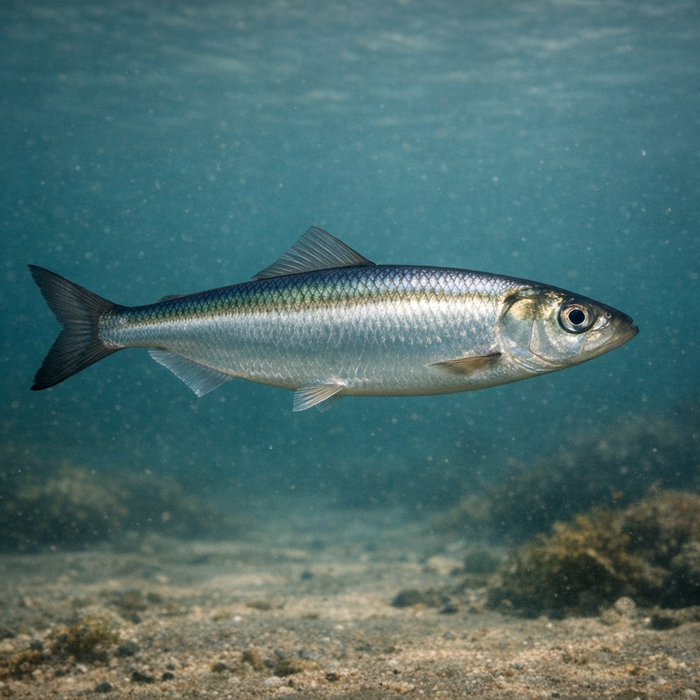
Sardine (Sardina pilchardus): The Small Silver Fish That Keeps Bigger Fish in Business
The Sardine gets treated like a supporting actor: bait, dinner, something packed into a tin. That undersells a fish whose importance runs straight through coastal food webs and working waterfronts. Sardina pilchardus, also called the European pilchard, is a schooling saltwater species found around Europe and northwestern Africa. Its commercial value is substantial, but its ecological job is bigger still: turning plankton into food that larger predators can actually chase.
For anglers, the appeal is different from trophy hunting. This is light-tackle fishing built around finding the right school and presenting something appropriately small. The supplied fishing approach is miniature sabiki jigging, not a scaled-down excuse to throw heavy hardware. Think precision, observation, and restraint. The fish may be small. Your approach still matters.
What Makes the Sardine Unique?
Start with its feeding flexibility. This species can filter tiny food particles from the water, then switch to taking larger plankton individually. That ability helps explain why calling it simply a plant eater or a miniature predator misses the point. Its diet can include both phytoplankton and animal plankton, with their importance changing between regions and seasons. Among useful Sardine facts, that adaptability deserves more attention than the familiar silver finish.
Identification has some excellent close-up clues. The lower gill cover carries three to five pronounced radiating ridges, and the final two anal-fin rays are noticeably enlarged. Those details are much more useful than assuming every small, shiny fish is the same species. The streamlined body and rounded belly complete the picture: compact, efficient, and recognizably different once you know where to look.
Habitat & Global Range
Sardine habitat is open water, whether that water lies close to shore or farther across the continental shelf. Its range includes the northeastern Atlantic, Mediterranean, and Black Sea, extending south along northwestern Africa. Coastal waters around Portugal, Spain, France, and Morocco fall within that distribution, but a country name is not a promise of fish beneath the nearest pier. Schools move, and local abundance changes.
Published descriptions commonly place schools around 25–55 metres deep during daylight, with shallower positions at night. These are tendencies rather than fixed operating depths. For fishing purposes, the important distinction is that this is a suspended-water-column fish, not something reliably pinned to a reef, wreck, or patch of bottom. Search the water above structure instead of assuming the structure itself is the attraction.
Behavior & Temperament
The Sardine operates in schools and makes movements within marine waters. That means availability can change without anything being wrong with your tackle. A productive stretch of coast can go quiet when the fish move beyond casting range or settle at a different depth. Published accounts also describe schools rising into shallower water at night. Your fishing plan should leave room for that mobility.
There is another useful distinction: visible fish are not automatically willing fish. A plankton-feeding school does not owe your rig a response. Treat fine feather or fishskin presentations as tools to test, not magic passwords. Begin gently, vary the depth, and resist the urge to compensate for uncertainty with increasingly violent rod movements. The challenge is making contact with the right school, not demonstrating how hard you can jig.
Ecological Importance
The Sardine connects microscopic production with much larger marine animals. By feeding low in the food web and becoming prey itself, it makes plankton-derived energy available to predatory fish, seabirds, and marine mammals. A school is therefore more than a collection of potential catches. It is a moving food supply with consequences well beyond its own body size.
Its importance also reaches shore. Fisheries supply fresh and preserved food, while catches can also be used as bait or processed into fishmeal and oil. That combination of ecological usefulness and commercial demand explains why this modest-looking species receives serious fisheries attention.
Conservation & Environmental Pressures
The Sardine is globally classified as Least Concern, but that category is not a declaration that every regional stock is healthy. The published global assessment is older, and fisheries management examines individual stocks rather than treating the entire range as one interchangeable population. Local abundance, recruitment, fishing pressure, and environmental conditions all matter to the practical picture.
Research has linked changes in plankton food size with differences in growth and body condition in Mediterranean fish. Experiments have also documented plastic-fibre ingestion, with feeding mode influencing how much was swallowed. Those findings deserve attention without turning a complicated fisheries story into a single-cause slogan. Abundance depends on more than whether somebody saw an impressive school yesterday.
The FishyAF Take
The Sardine does not need a trophy-sized makeover to deserve respect. Calling it merely bait is like calling a fuel tanker merely traffic. This is a small fish doing consequential work, and fishing for it rewards an angler willing to pay attention.
Bring the light outfit. Find the school. Keep your presentation modest and your expectations honest. If you retain fish, have a lawful purpose and a proper chilling plan. The best version of this fishery is not a frantic race to fill something. It is a reminder that good angling starts with understanding the fish, even when the fish could fit comfortably beside your sandwich.