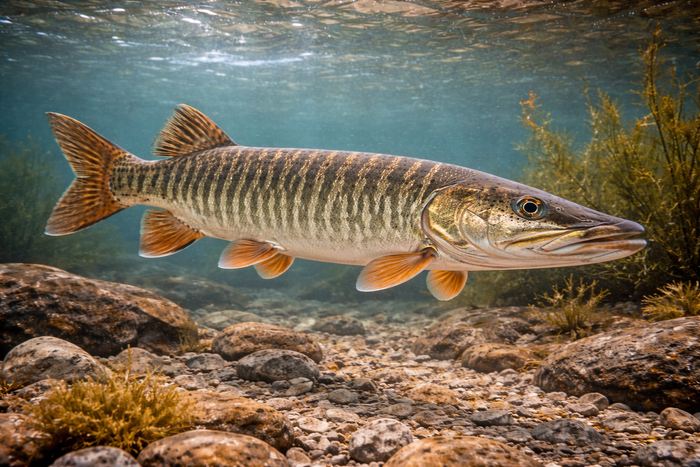
Amur Pike (Esox reichertii): Black Spots, Sharp Teeth, Zero Interest in Your Excuses
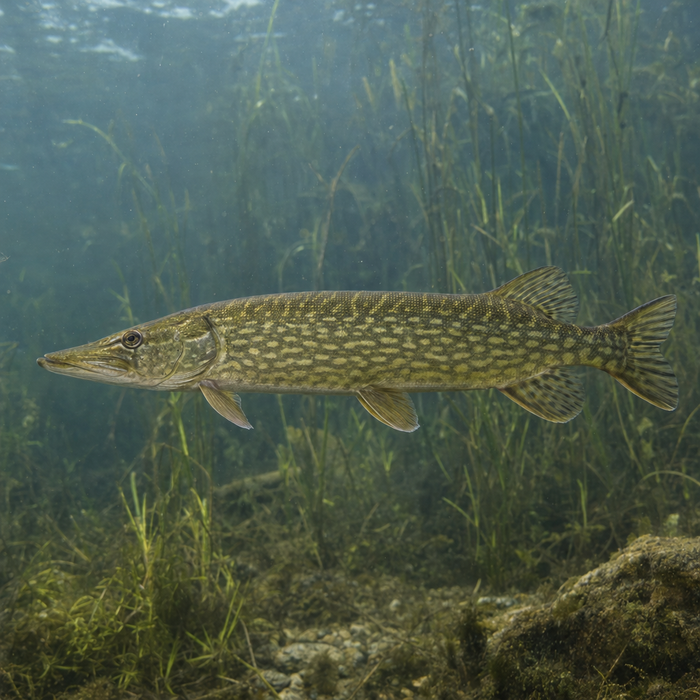
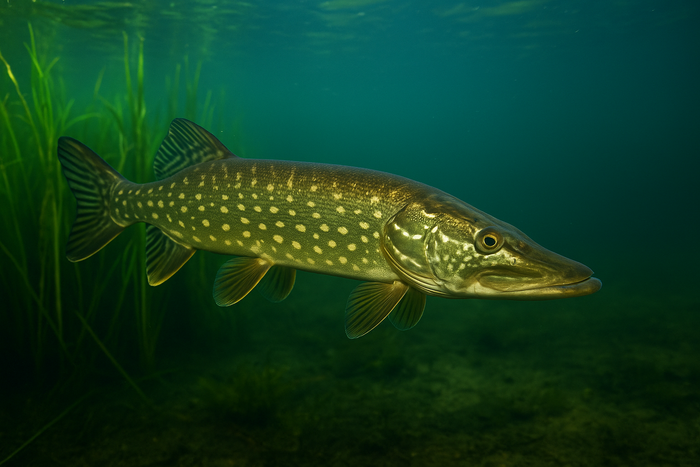
The Amur Pike looks familiar until you notice the paint job. That long, predatory silhouette belongs unmistakably to the pike family, but the silvery body scattered with small dark spots gives this East Asian species its own identity. It is also called the blackspotted pike, and the nickname does not require much detective work. This is a distinct species, not a northern pike wearing regional camouflage.
For anglers, the appeal goes beyond identification. Lowland rivers, floodplain lakes and connecting channels provide a setting where finding the right water matters as much as choosing the right spoon. The typical fish in this guide measures 20–24 inches and weighs 2–5 pounds: manageable tackle, meaningful teeth and plenty of reason to pay attention. You do not need a monster to make the encounter worthwhile.
What Makes the Amur Pike Unique?
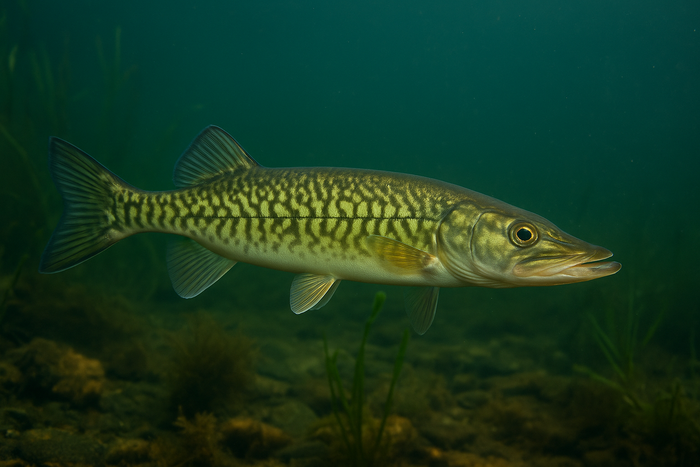
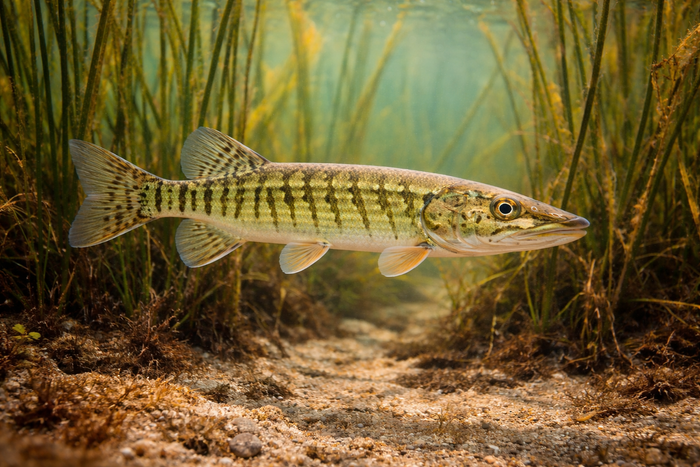
The adult markings are the headline. Instead of the familiar pale markings against a darker northern pike body, this species carries dark spots on a lighter background. Young fish can look different, showing inclined bars before developing the more recognizable adult pattern. That change makes identification less straightforward when the fish is small.
Another distinction sits beneath the obvious color differences: compared with northern pike, it has smaller scales and more extensive scaling over the head. These are genuine anatomical differences, not just details invented to give another spotted fish a personality.
Then there is its surprising reproductive compatibility. Despite being separate species, Amur and northern pike can produce fertile hybrids. Among Amur Pike facts, that one deserves more attention than another breathless description of sharp teeth. Species boundaries can be biologically complicated, even when the names look tidy.
Habitat & Global Range
Amur Pike habitat centers on the freshwater systems of East Asia. Its native distribution includes Russia, China and Mongolia, with freshwater populations also documented on Sakhalin Island. The Amur drainage is central to its identity, but the distribution is broader than one stretch of one famous river.
The fisheries highlighted here include the Amur and Ussuri rivers, Lake Khanka, the Songhua River and Buir Lake. Think lowland river margins, backwaters, floodplain lakes and the channels connecting them. A major river's name gets you into the right region; it does not tell you which bank deserves your first cast.
Water levels matter because floodplain habitat is not fixed. Rising water can reconnect feeding and reproductive areas, while falling water changes access and concentrates the remaining connections. For trip planning, ask about current conditions rather than treating an old productive spot as permanent infrastructure. Floodplain rivers do not sign contracts with anglers.
Behavior & Temperament
This predator rewards anglers who notice edges rather than simply admire acreage. Firsthand fishing accounts describe catches around vegetation, submerged wood, quiet bays and current reversals, with autumn opportunities around outlets connecting lakes and channels to the main river. Those observations support a practical approach: work promising features deliberately instead of casting blindly across open water.
Spoons, spinners and minnow plugs fit that approach well. Keep the presentation controllable, vary the retrieve and avoid changing everything after one empty cast. Intermediate difficulty is a sensible designation here. The challenge is not mastering a mysterious technique; it is putting an appropriate lure through water that actually holds fish.
Ecological Importance
The Amur Pike is both a predator and a fishery resource. It is recognized as a commercial species as well as a gamefish, so its importance is not confined to recreational photographs. Its place in the food web and its value to people overlap, sometimes comfortably and sometimes not.
Reproduction ties it to the surrounding landscape. In Mongolia, spawning is documented on flooded floodplains, with timing influenced by water temperature. That means shallow seasonal habitat is more than attractive fishing scenery. It helps produce the next generation. Protecting only the permanent river channel misses part of the system that keeps the fishery functioning.
Conservation & Environmental Pressures
The species is assessed as Least Concern, consistent with this guide's conservation status. That classification describes global extinction risk; it is not a guarantee that every local population is abundant or every fishery can absorb unlimited pressure.
Research in the Amur basin documents how regulated flows can reduce floodplain inundation, interrupt connections and damage spawning habitat for vegetation-spawning fishes, including this species. These pressures deserve attention alongside harvest. A river can still contain water while losing important parts of its seasonal ecological machinery.
The FishyAF Take
The Amur Pike does not need borrowed muskie mythology or an unverified world-record number to be interesting. Its markings, regional identity and floodplain setting already make a strong case.
Our verdict: fish it thoughtfully, handle it properly and stop measuring every worthwhile predator against the biggest fish on somebody else's wall. Bring a bite-resistant leader, useful unhooking tools and the patience to read changing water. The spots make the photograph. Good decisions make the day.