Tiger Muskie (Esox masquinongy × Esox lucius): Two Predators, One Very Bad Day for Your Bucktail
The Tiger Muskie looks like somebody gave a muskie a sharper wardrobe and absolutely no interest in making your afternoon easy. Bold bars, a long body, and a mouth built for grabbing fish make the first impression. The second usually involves your drag. This freshwater predator belongs to the pike family, Esocidae, but it is not a separate biological species: it is a hybrid between muskellunge and northern pike. That distinction explains far more than its scientific name. It shapes its growth, reproduction, fisheries management, and the places anglers encounter it.
What Makes the Tiger Muskie Unique?
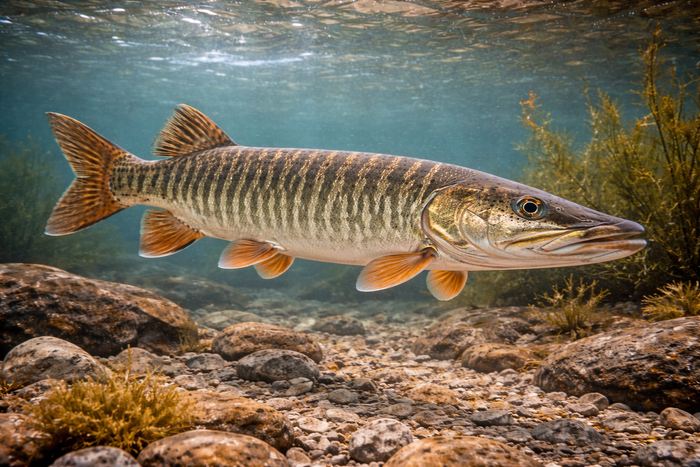
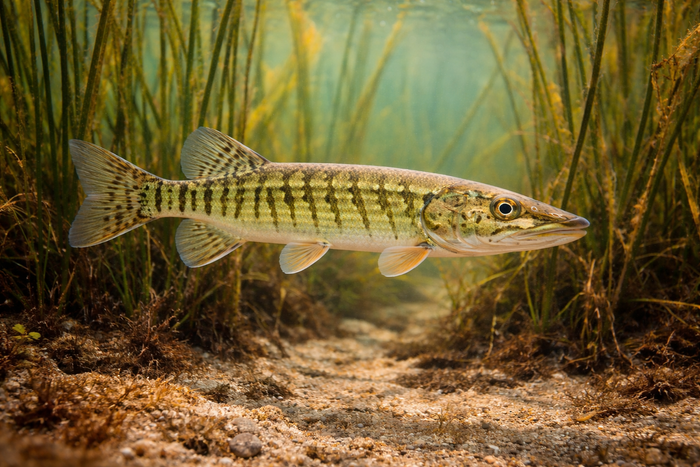
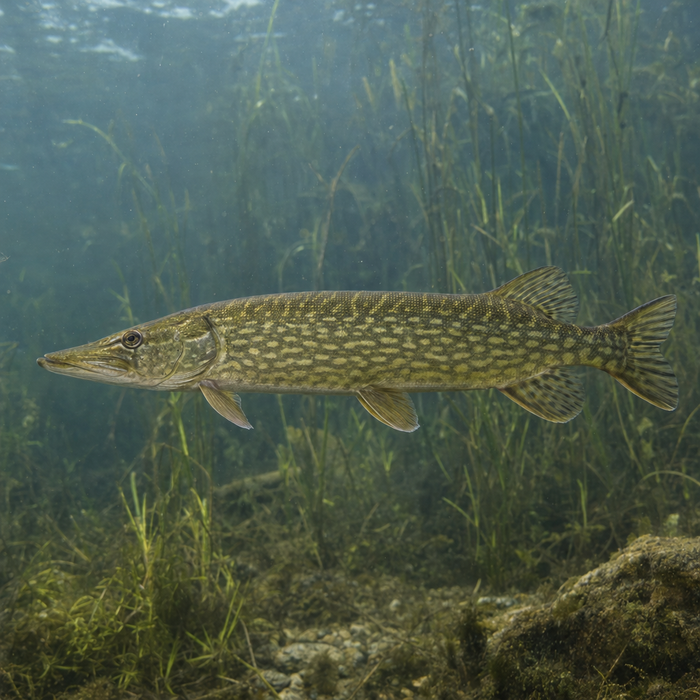
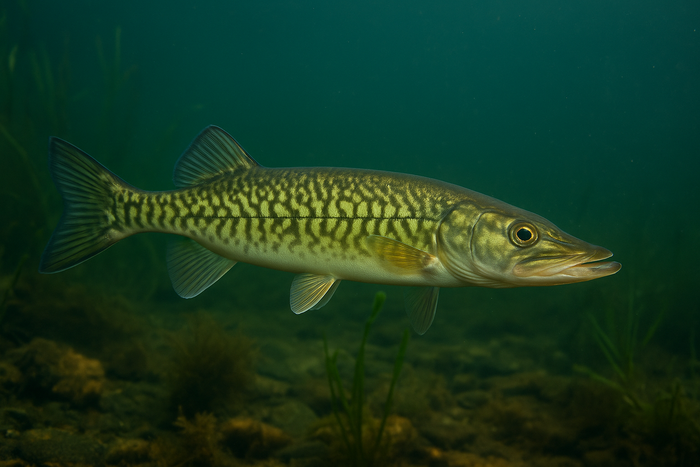
Three traits deserve the spotlight. First, those irregular vertical bars can merge across the back into an interlocking pattern, giving the fish a genuinely distinctive appearance. Rounded tail lobes also separate it from the sharply pointed tail of a typical pure muskellunge. Second, early growth can be remarkably fast; fisheries descriptions report growth approaching twice that of its parents during the first few years. Third, the hybrid is generally sterile, so stocked populations do not normally replace themselves through reproduction.
Those Tiger Muskie facts belong together. This is not simply a striped version of an ordinary muskie. It combines recognizable parental characteristics with reproductive limitations that make it unusually useful for carefully controlled stocking programs.
Habitat & Global Range
Tiger Muskie habitat includes vegetated freshwater lakes, reservoirs, and slower river environments. Weedbeds, submerged timber, and transitions between cover and open water offer useful starting points, but fish also occupy deeper, less obvious areas. Treat the weeds as an introduction, not the entire address book.
Natural hybrids can occur where northern pike and muskellunge overlap in North America. Stocking has expanded fishing opportunities beyond that overlap, including western waters. For anglers in the Great Lakes, Midwest, and Northeast, established examples include Otisco and Conesus lakes in New York, plus Minnesota's Lake Elmo, Lake Johanna, and Lake Phalen. Presence alone does not guarantee equal abundance or equal fishing quality. Check recent stocking information and surveys rather than assuming every muskie label means the same fishery.
Behavior & Temperament
The Tiger Muskie is an ambush predator, but the idea that every individual spends its life parked beside one weed clump is too neat. Tracking research in Washington documented fish that stayed within small shoreline areas and others that traveled many kilometers over short periods. Movement differed between lakes, too. The practical lesson is simple: yesterday's sighting is useful information, not a reservation.
Fish dominate its diet. Washington fisheries guidance identifies large, soft-rayed prey, including suckers and northern pikeminnow, as important foods. For anglers, casting and trolling both make sense because they cover potential holding areas efficiently. Bucktail spinners, jerkbaits, and crankbaits are established options. A flashy presentation still needs to pass a fish that is willing to commit.
Ecological Importance
The Tiger Muskie is both a predator and, in many waters, a deliberate fisheries-management tool. Managers have introduced it to create trophy angling opportunities and apply predation pressure to selected abundant fish populations. Washington projects, for example, have targeted northern pikeminnow or tench. Sterility allows managers more control over predator numbers than a freely reproducing introduction would provide.
That does not mean stocking automatically fixes a crowded fish community. Outcomes depend on the lake, available prey, survival, and the number of fish introduced. A program's objective is not the same thing as a proven result. The sensible approach is monitoring, not declaring that one impressive predator has solved the ecosystem. Its ecological role should be judged water by water.
Conservation & Environmental Pressures
For a stocked hybrid, conservation often means protecting the quality and continuity of a fishery rather than preserving a self-sustaining species population. Stocking, survival, harvest, and release mortality all matter. The Not Evaluated status should not be mistaken for proof that local populations face no pressures. Water quality matters as well: Lake Elmo has a fish-consumption advisory associated with PFOS contamination, a reminder that clear water is not automatically clean water.
Anglers control one important part of the equation. Strong tackle shortens fights, while a large coated net, long pliers, and hook cutters make safer releases possible. Keep the fish submerged during unhooking whenever practical, minimize air exposure, and support it horizontally. The photograph is optional. A functioning fish is not.
The FishyAF Take
The Tiger Muskie deserves more respect than the phrase “hybrid fish” sometimes gets. It is not a consolation prize for missing a pure muskie. The markings are spectacular, the early growth is impressive, and the fishing demands preparation. That combination earns its own lane.
Bring tackle that matches the job, not tackle that makes the fight sound heroic afterward. Learn the water, inspect the leader, and have the release tools ready before anything eats. The real flex is not dragging a striped predator into the boat with inadequate gear. It is being ready when the opportunity arrives—and sending the fish back in good shape.