Banded Wobbegong (Orectolobus halei): The Reef Rug With a Shark Attached
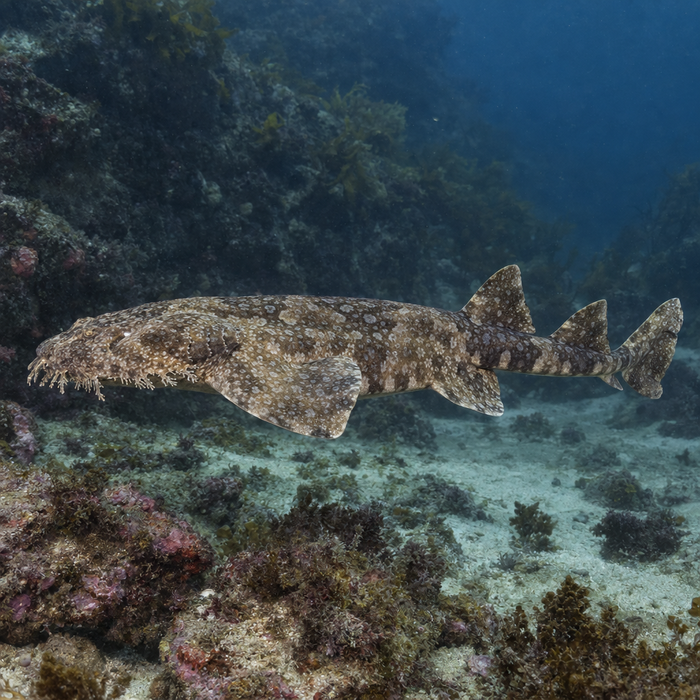
The Banded Wobbegong makes a convincing argument that sharks do not need to patrol dramatically to command respect. Broad-headed, beautifully patterned, and usually parked against the bottom, this Australian predator specializes in being overlooked. Its apparent laziness is part of the package: camouflage and patience put dinner within striking distance. This is a carpet shark, not underwater furniture, however much it resembles something growing over a rock.
For anglers, that distinction matters. A bottom bait can produce an encounter with a substantial shark whose quiet appearance gives absolutely no permission for casual handling. Wobbegongs can bite when disturbed and reach back toward someone holding their tail. Admire the disguise; respect what is underneath it.
What Makes the Banded Wobbegong Unique?
Start with the camouflage. Dark, black-edged saddles break across a brownish body, while branched skin lobes fringe the head. Against complicated reef scenery, that combination disrupts the familiar outline of a shark. Two raised knobs above the eyes and pale spots behind the spiracles add useful identification details. The overall effect is elaborate, but it is not random decoration. This is a predator dressed for close-range work.
Then there is the identity problem. Orectolobus halei was once treated as the adult form of the smaller ornate wobbegong before being restored to full species status in 2006. Common names remain inconsistent: Gulf Wobbegong is another established name, while some references apply Banded Wobbegong to Orectolobus ornatus. Among useful Banded Wobbegong facts, that scientific-name check deserves more attention than it usually gets. Otherwise, you can accidentally research the wrong shark.
Habitat & Global Range
This species is endemic to Australia. Its distribution wraps around the southern part of the continent, extending from southern Queensland through New South Wales, Victoria, and South Australia to Western Australia, with records around Flinders Island in Bass Strait. Overseas records historically assigned to this species require caution because of identification confusion. Australia is the correct starting point, not a generic Indo-Pacific fishing map.
Banded Wobbegong habitat includes coastal rocky reefs, bays, macroalgal reef areas, offshore islands, and some coral reef environments. Caves, ledges, channels, and broken bottom provide daytime shelter. Its documented depth range extends from very shallow water to approximately 195 meters, although many familiar encounters occur on accessible inshore reefs. Think marine structure and cover rather than freshwater-influenced estuary fishing simply because a location happens to be called a bay.
Behavior & Temperament
The Banded Wobbegong is primarily nocturnal, commonly resting under cover by day and making excursions away from resting areas at night. That does not make daylight encounters unusual; resting sharks can be conspicuous once you know what to look for. Nor does nighttime activity establish a guaranteed fishing window. Presence, feeding, and willingness to take a bait are different things.
It can also be a committed local. Acoustic tracking at Fish Rock documented individuals regularly detected over periods reaching 20 months, supporting meaningful site attachment. That is a better picture than imagining every shark as a restless long-distance cruiser. A familiar reef may hold a familiar resident, which makes repeatedly pressuring the same patch worth questioning. Stillness is a hunting strategy, not evidence that the animal is harmless or that the reef needs another removal.
Ecological Importance
As a substantial predator, this shark connects reef communities with a broader menu than its sedentary reputation suggests. Diet research found bony fishes, cephalopods, and cartilaginous fishes among wobbegong prey, with Orectolobus halei taking pelagic fishes and other cartilaginous fishes more frequently than the other species examined. It is not merely picking scraps off the seabed. Its feeding position means removing predators can have consequences farther down the food web.
Conservation & Environmental Pressures
The Banded Wobbegong is assessed as Least Concern, consistent with its current global conservation listing. That label should not be confused with unlimited resilience. Commercial and recreational fisheries encounter it as both catch and bycatch, and its site attachment can concentrate fishing pressure locally. A shark does not become replaceable because the global assessment is reassuring.
Reproduction also deserves respect: females carry developing young for roughly 10–11 months and can produce large litters, but reproductive output alone does not erase fishing pressure. Management has helped reduce historical targeting. In New South Wales, recreationally caught wobbegongs must be released. Check the rules where you fish rather than borrowing permissions from another state or confusing commercial arrangements with recreational rights.
The FishyAF Take
This shark does not need a glamorous reputation. It has already made looking like reef clutter into a viable predatory career. That is considerably more impressive than its nickname suggests.
The right encounter ends with identification, restrained handling, and a sensible release wherever required. A stationary shark is not an invitation to improvise around its mouth. Appreciate the camouflage, keep your ego out of the handling plan, and let the reef rug get back to being a shark.