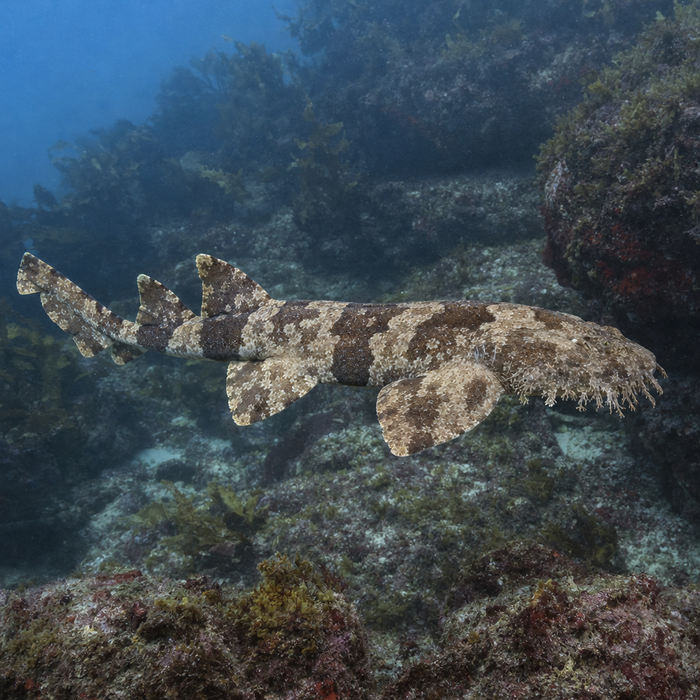
Spotted Wobbegong (Orectolobus maculatus): The Reef Has Teeth, and You Nearly Stepped on Them
Most sharks announce themselves with a fin. The Spotted Wobbegong would rather you mistake it for the bottom. Flattened, fringed and patterned like an extravagant old carpet, this coastal ambush predator makes being overlooked a serious hunting advantage. Its unhurried appearance is convincing right up until something edible enters striking distance. Then the decoration becomes a mouth. Camouflage and ambush feeding are central to its identity.
For anglers, that creates an unusual encounter: a shark associated with reef structure and bottom baits rather than open-water pursuit. It deserves interest, but also considerably more respect than its lounging posture suggests.
What Makes the Spotted Wobbegong Unique?
Start with the disguise. Dark saddles and pale, ring-shaped markings cover a yellowish to greenish-brown background. Branched skin lobes fringe the head, breaking up its outline against complicated bottom structure. Those whitish rings extend into the dark saddles, helping distinguish this species from similar wobbegongs. Identification takes more than noticing that a shark looks shaggy.
Then there is the feeding machinery. The Spotted Wobbegong can thrust its jaws forward while expanding its mouth cavity to generate suction. Research measured jaw protrusion equivalent to about one-third of its cartilaginous skull length. That is a substantial mechanical upgrade for an animal whose hunting strategy includes sitting still. Among Spotted Wobbegong facts, this is the one that should permanently retire the phrase harmless carpet. The mouth is not merely wide; it is built to close the distance.
Habitat & Global Range
This is an Australian saltwater shark, distributed around substantial stretches of the mainland's eastern, southern and western coasts. Rocky reefs, sandy patches, coastal bays and seagrass areas all feature in Spotted Wobbegong habitat. Reef ledges and sheltered bottom structure provide daytime resting opportunities. Older reports from Japan and the South China Sea are generally regarded as probable identification errors, not evidence of a dependable overseas population.
Although commonly associated with shallow coastal water, published records extend to approximately 218 metres. Juveniles also use estuaries and seagrass habitats. A beachside reputation therefore tells only part of the story: this shark occupies more of the continental shelf than casual sightings suggest.
Behavior & Temperament
The Spotted Wobbegong is primarily nocturnal, commonly resting during daylight and feeding after dark. Remaining motionless is part of its predatory toolkit, not evidence of an inability to move. Its long, sharp teeth can cause serious injuries, and a biting animal may be reluctant to release its grip. Quiet does not mean safe to touch.
Its social life is less solitary than appearances suggest. Tracking research found nonrandom associations between particular individuals, with some relationships persisting after seasonal absences. That does not make these sharks a tightly coordinated hunting pack. It does mean that several animals sharing a reef cannot automatically be dismissed as strangers occupying convenient parking spaces.
Ecological Importance
As a bottom-associated predator, this species connects reef and coastal food webs through its consumption of fishes, cephalopods and other prey. Stomach-content research documents a varied menu rather than dependence on one food source. Its hunting apparatus allows it to exploit close-range opportunities without relying exclusively on lengthy pursuit.
Reproduction adds another important dimension. Females give birth to live young after embryos develop using yolk reserves rather than a placenta. Research in New South Wales found a three-year reproductive cycle and litters averaging about 21 pups. A substantial litter is not an annual replacement programme; the interval between reproductive events matters when assessing how populations withstand removals.
Conservation & Environmental Pressures
The Spotted Wobbegong is assessed globally as Least Concern, consistent with its broad Australian distribution and managed fishing pressure. That label should not be confused with immunity to local depletion. Site attachment can leave animals exposed to repeated fishing in the same places, and the species enters both targeted fisheries and incidental catches.
For recreational anglers, local rules are decisive. New South Wales currently requires wobbegongs to be released. A global conservation category does not override that obligation. Plan any permitted fishing around safe release, and never lift a wobbegong by its tail: it can reach back and bite the person holding it. Keep hands clear of the mouth and avoid dragging an animal across rocks.
The FishyAF Take
This shark is proof that speed is not the only impressive thing in the ocean. The disguise, patience and forward-reaching bite are a complete system, not a collection of odd accessories. Calling it ugly misses the point. Calling it harmless misses a more important one.
Our take: appreciate the animal before deciding it needs to become a catch. Where fishing is permitted, use tackle and a release plan appropriate to the situation. Where safe handling is doubtful, leave the bait in the cooler. The best story is not that you wrestled the reef carpet. It is that you understood what you were looking at.