Giant Trevally (Caranx ignobilis): The Reef Bully That Hits Like a Truck
The Giant Trevally is what happens when a jack grows up angry, gets built like a torpedo, and decides the reef belongs to it. Known across the Indo-Pacific as GT, ulua, barrier trevally, or giant kingfish, Caranx ignobilis is not just another silver predator with a forked tail. It is the heavyweight bouncer of coral edges, surf lines, reef passes, and tropical flats. For anglers, few fish combine visual violence, brute strength, and instant regret quite like a big one eating a popper in knee-deep water.
Among serious saltwater casters, Giant Trevally facts tend to sound exaggerated until you watch one happen. They smash topwater lures with the confidence of a fish that has never read a drag rating. They use coral heads like weapons. They turn expensive hooks, split rings, and egos into loose parts. This is why the species sits in that rare category where the bite is thrilling, but the next ten seconds determine whether you are fishing or simply donating tackle to geology.
What Makes the Giant Trevally Unique?
First, size. The Giant Trevally is the largest member of the genus Caranx in the Indo-Pacific, with ordinary adult fish already powerful and exceptional fish pushing into ridiculous territory. Fish in the 15- to 25-pound range are serious opponents; 50-pounders are memorable; true giants above 100 pounds are the ones that make anglers speak more softly afterward.
Second, attitude. This species is not a delicate ambush artist waiting politely in the shadows. It patrols reefs, channels, flats, and drop-offs like it owns the map. Adults often hunt alone or in small groups, but they can also gather in large numbers, especially around spawning-related aggregations. Their feeding behavior is famously aggressive: baitfish, crustaceans, cephalopods, and whatever else looks edible may get the full demolition package.
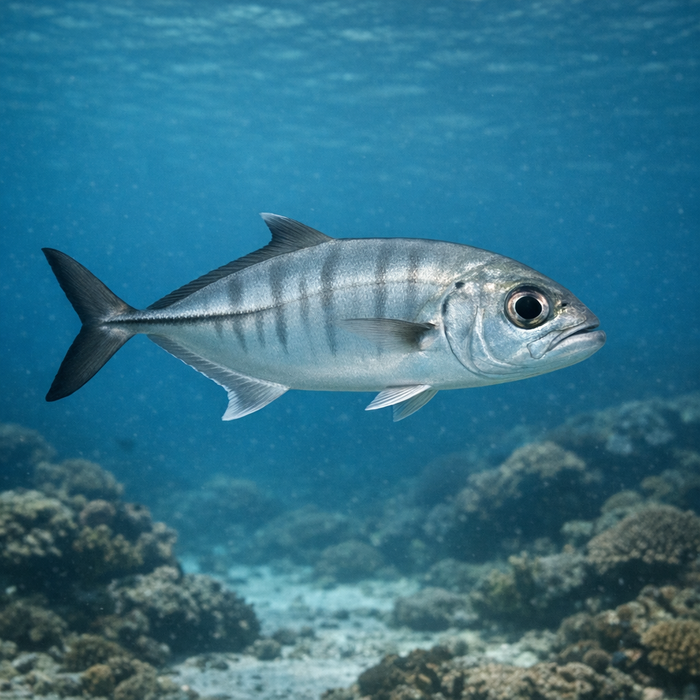
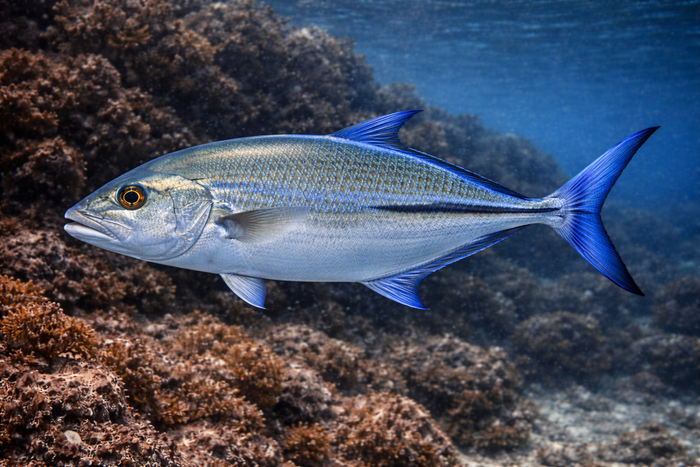
Third, hardware. A deep head, thick shoulders, narrow wrist, and big forked tail make the Giant Trevally a pure acceleration machine. That body shape is why a fish can appear from nowhere, detonate on a lure, and be halfway to the coral before your brain has filed the paperwork.
Habitat & Global Range
Giant Trevally habitat stretches across warm Indo-Pacific waters, from the western Indian Ocean and Red Sea region through island chains, Southeast Asia, northern Australia, Oceania, Japan, and out toward central Pacific islands including Hawaii. It is strongly associated with tropical and subtropical marine environments, especially coral reefs, rocky coasts, reef passes, lagoon edges, surf zones, flats, and outer drop-offs.
Juveniles may use protected lagoons, estuaries, bays, and shallow nearshore areas. Adults are more often tied to high-energy structure: current-swept reef points, channels, bombies, atoll passes, ledges, and surf-pounded shorelines. That does not mean they are always deep. Some of the most savage encounters happen in painfully shallow water, where a black-backed fish materializes over pale sand and turns a stickbait into evidence.
Behavior & Temperament
The Giant Trevally is an apex reef predator, and it behaves like one. It feeds actively in current, low light, turbulent water, and along edges where smaller fish get funneled into bad decisions. In some regions, night feeding is well known, while in clear tropical flats, daytime sight-casting can produce some of the most cinematic eats in fishing.
This species is also smarter than its brick-shaped head suggests. Big fish learn structure, routes, pressure, and opportunity. They are capable of sudden bursts, violent direction changes, and brutal use of cover. Hook one near coral and the fight becomes a street fight in a phone booth: short, ugly, and usually decided early.
Ecological Importance
As a top predator, the Giant Trevally helps shape reef food webs. It pressures schooling baitfish, mid-level predators, and reef-edge prey species, moving energy between flats, lagoons, channels, and outer reef zones. Large individuals are not just trophies; they are functional predators with outsized ecological influence.
Their aggregations also matter. Documented mass gatherings show that local populations may depend on specific places and seasonal timing. When those sites are predictable, they can be productive for anglers but risky for the fish if harvest is unmanaged.
Conservation & Environmental Pressures
Globally, the Giant Trevally is listed as Least Concern, but that label is not a free pass. Large reef predators are vulnerable to local depletion, especially where spawning aggregations, reef passes, or famous shore spots receive heavy pressure. Habitat degradation, coral reef decline, commercial harvest, recreational overharvest, and poorly managed tourism fisheries can all chip away at local abundance.
Catch-and-release is common in elite GT fisheries, especially for large fish. That only works when anglers use strong tackle, minimize fight time, handle fish carefully, and release them quickly. A fish beaten to exhaustion for a hero photo is not conservation. It is just bad math with a camera.
The FishyAF Take
The Giant Trevally is not popular because it is easy. It is popular because it is unfair in exactly the way great gamefish should be. It punishes weak gear, lazy knots, cheap terminals, bad angles, and hesitation. It turns tropical postcard water into a boxing ring.
If bonefish are chess and tarpon are theater, the Giant Trevally is a bar fight on a coral reef. Respect the fish, upgrade everything, pull harder than feels reasonable, and remember: the reef was there before you, and the GT knows every inch of it.