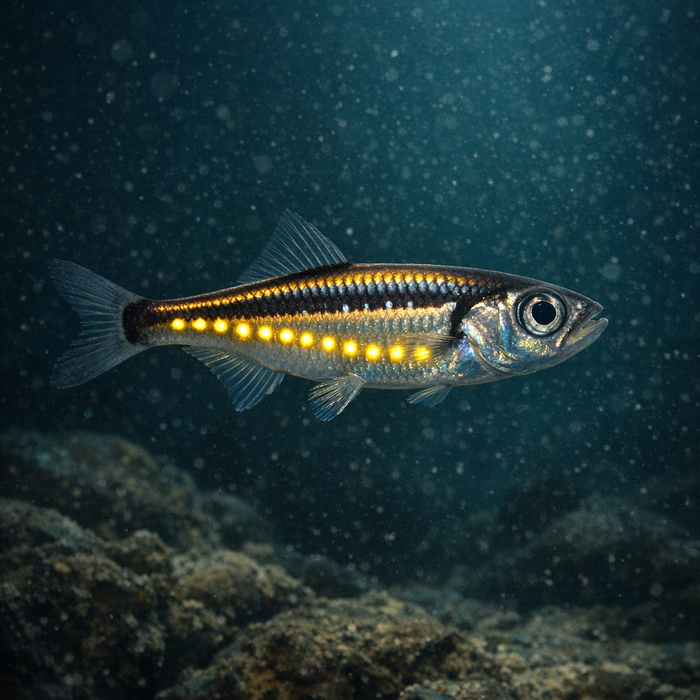
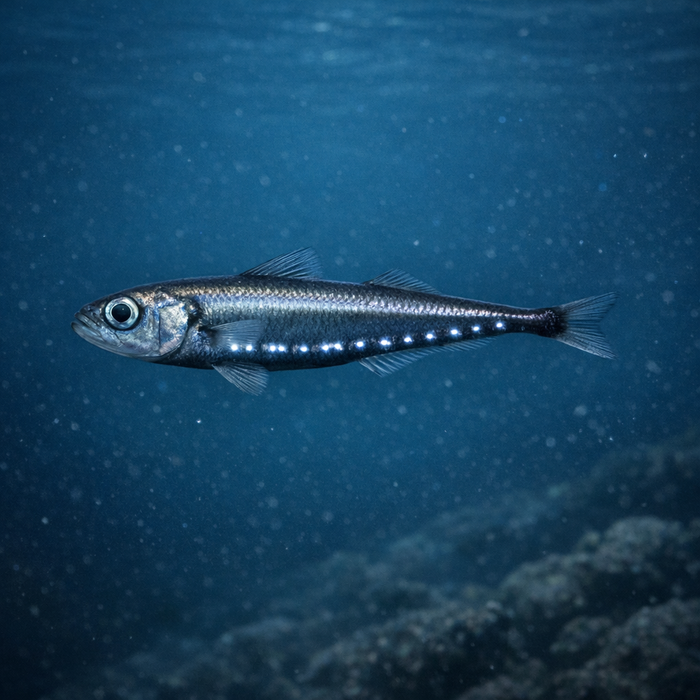
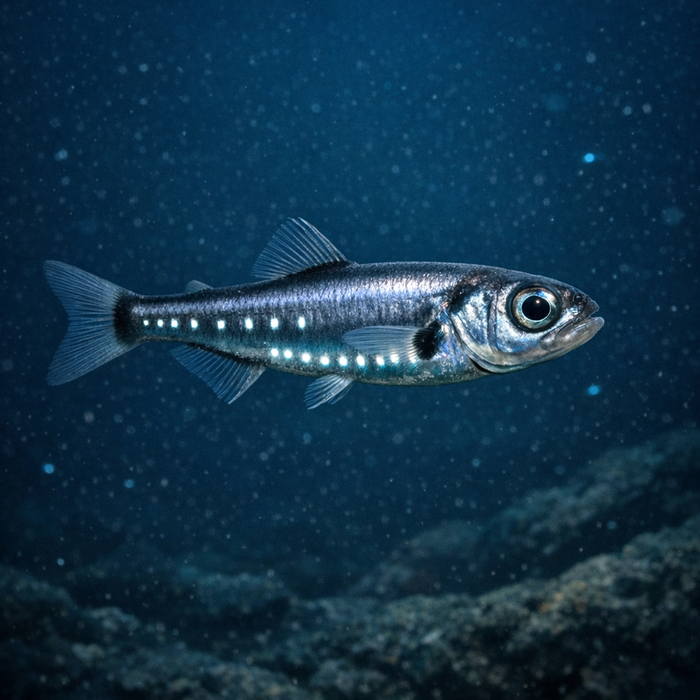
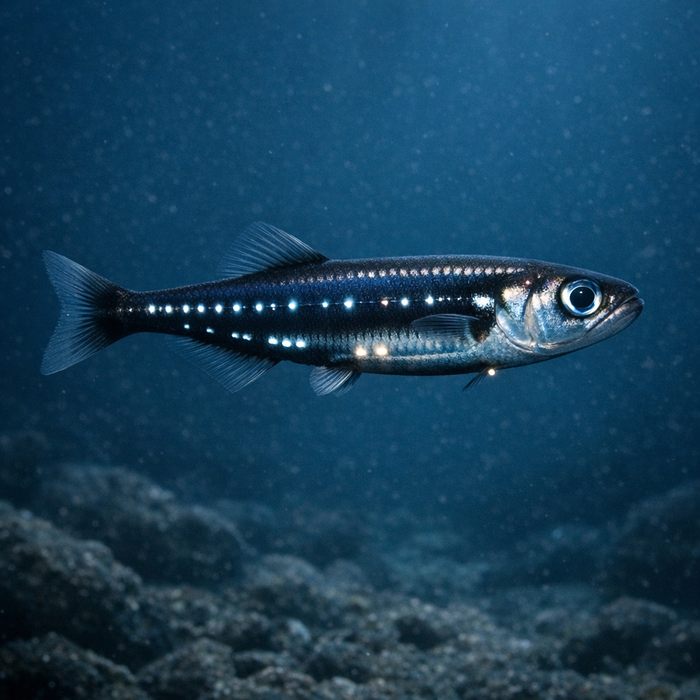
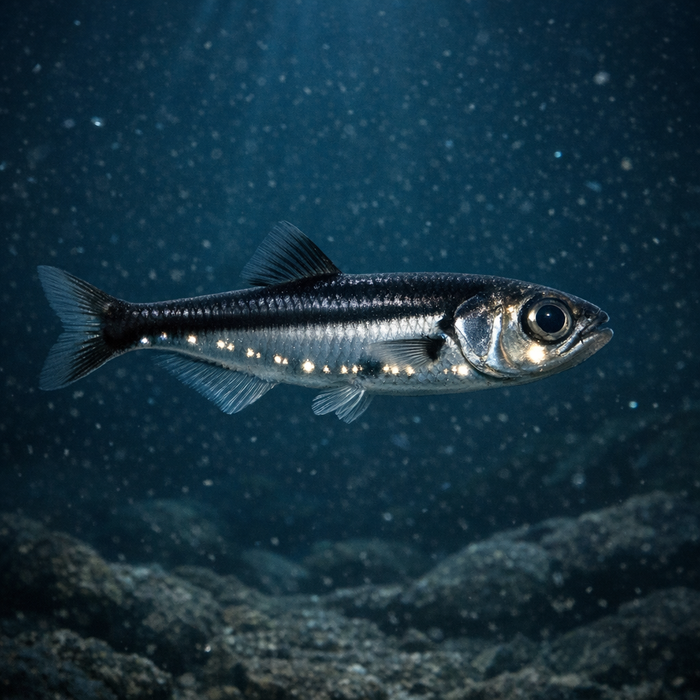
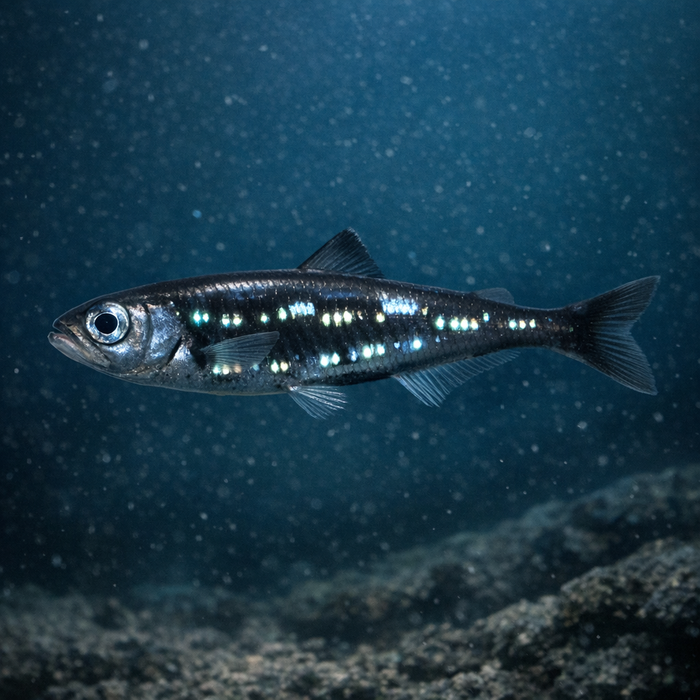
Laura's lantern fish (Loweina rara): A spark from the deep that blinks in, feeds fast, and fades to black.IntroductionLaura's lantern fish is the little night rider almost no angler sees on purpose. It is a midwater specialist, tiny and lit with pinpoint photophores, that commutes up from the deep scattering layer after dark. While most folks obsess over tuna and swords, this glow-patched micro predator is busy moving entire calories between the ocean's basement and its roof. If you want Laura's lantern fish facts without the snooze, here's the gist: small body, giant role, zero patience for daylight.What Makes the Laura's lantern fish Unique?Two things pop. First, the light show. Laura's lantern fish carries carefully arranged photophores it can brighten or dim to match faint moonlight, a trick called counterillumination. Second, the commute. It is a card-carrying diel migrant, dropping deep by day and rising at night with clockwork precision. That rhythm helps the species dodge predators, hit plankton pulses, and assemble into layers dense enough to bounce ship sonar. Add big eyes for a headlamp look, and you have a fish that is built for darkness, not drama.Habitat & Global RangeThink open ocean more than shoreline. Laura's lantern fish works the mesopelagic, what many call the twilight zone, generally hundreds to more than a thousand feet down. By day it sinks into the dim, neutral water column. At night, it rides the elevator up toward richer plankton layers and sometimes into the reach of deck lights. Seamounts, canyon edges, and steep offshore drop-offs can concentrate prey and give you your best accidental shot. Exact distribution details are still being refined by researchers, but Laura's lantern fish habitat broadly aligns with tropical and subtropical bluewater where midwater layers are well formed.Behavior & TemperamentThis is not a brawler. Laura's lantern fish schools tight, tracks the faintest light gradients, and feeds quickly on small crustaceans and micro nekton. The species is tuned to darkness: large pupils, sensitive vision, and photophore control that trims its outline. It is also skittish around harsh light bursts, often hanging just outside the glare cone from boat lamps and drifting in when the brightness softens. Expect jittery, short bursts rather than long runs. Hook one and it is more about keeping tension than testing drag washers.Ecological ImportanceLanternfish sit on the conveyor belt that powers bluewater life. Laura's lantern fish hoovers up calories at night and returns them to depth by day, a living elevator that helps shuttle carbon into the deep ocean. In huge numbers, its clan forms the deep scattering layer that shapes the movements of billfish, tuna, squid, and whales that hunt the edges. When you hear scientists talk about ocean carbon pumps and midwater food webs, this is one of the thumbnail-sized cogs making that whole machine turn.Conservation & Environmental PressuresThere is no big-time sport fishery for Laura's lantern fish, and most interactions come from research trawls or incidental lights-at-night encounters. That does not mean zero pressure. Any increase in broad midwater harvest for reduction fisheries, plus warming seas that alter plankton timing, could reshuffle the deck for a species so tied to light and temperature cues. Add expanding offshore development and noise, and you have a lot of variables for a tiny fish that thrives on consistency.The FishyAF TakeYou will not stack Instagram likes with Laura's lantern fish. But if you are the kind who geeks out on systems, this microglow traveler is pure gold. It is proof that the ocean's scoreboard is not only measured in pounds. For anglers, the lesson is simple: lights attract life, and life layers up. Respect the night shift and you will spot patterns most never notice. If you ever lift a Laura's lantern fish over the rail, snap a clean photo, take a breath, and log the catch. You just touched a moving part of the planet. For more Laura's lantern fish facts and Laura's lantern fish habitat nuance, follow the light, not the hype.