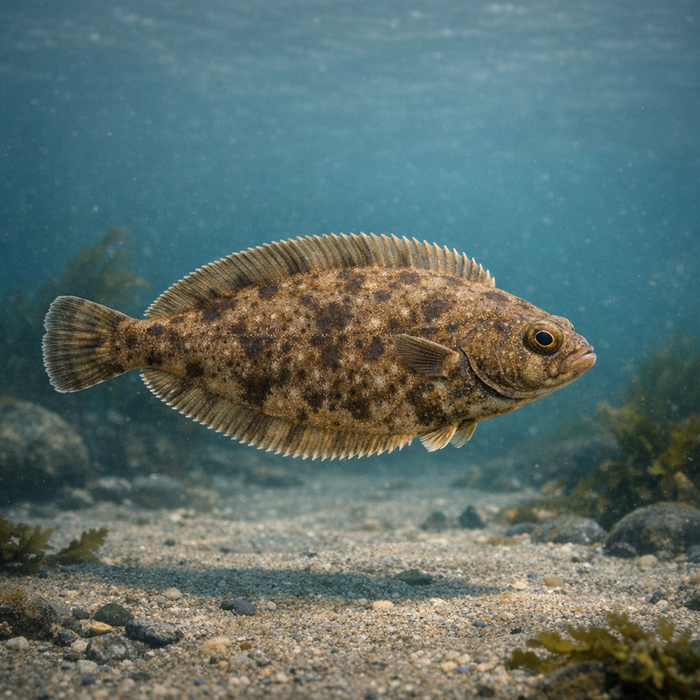
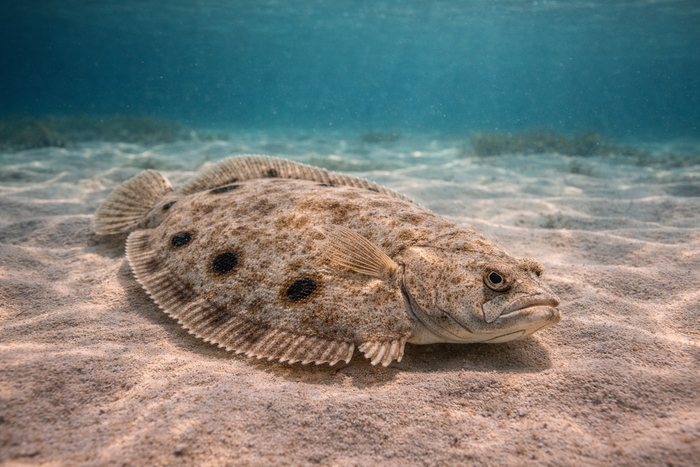
Olive Flounder (Paralichthys olivaceus): The Sand Has Eyes, and Your Bait Has a Problem
A sandy beach can look empty right up until something with teeth launches out of it. That is the appeal of the Olive Flounder: a predator built to disappear against the bottom, then abandon the disguise when dinner passes overhead. Its broad, flattened body suggests a quiet existence. Its feeding behavior tells a different story. This fish can rise off the seabed and pursue small fish rather than simply wait for food to land on its nose.
For anglers, the attraction is straightforward. Surf casting, bottom fishing, and lure work all fit the species, but reading water matters more than admiring your tackle collection. A blank-looking shoreline deserves a second look.
What Makes the Olive Flounder Unique?
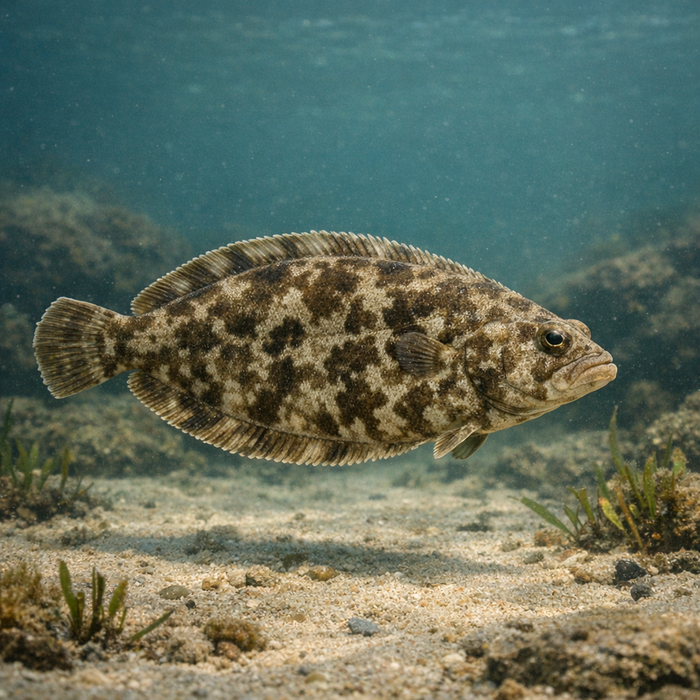
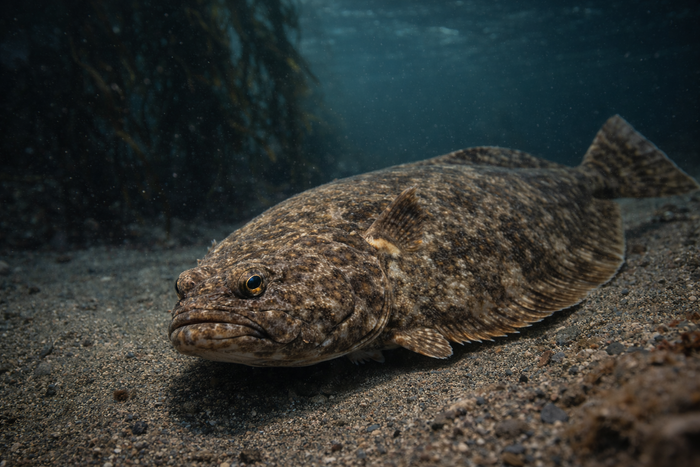
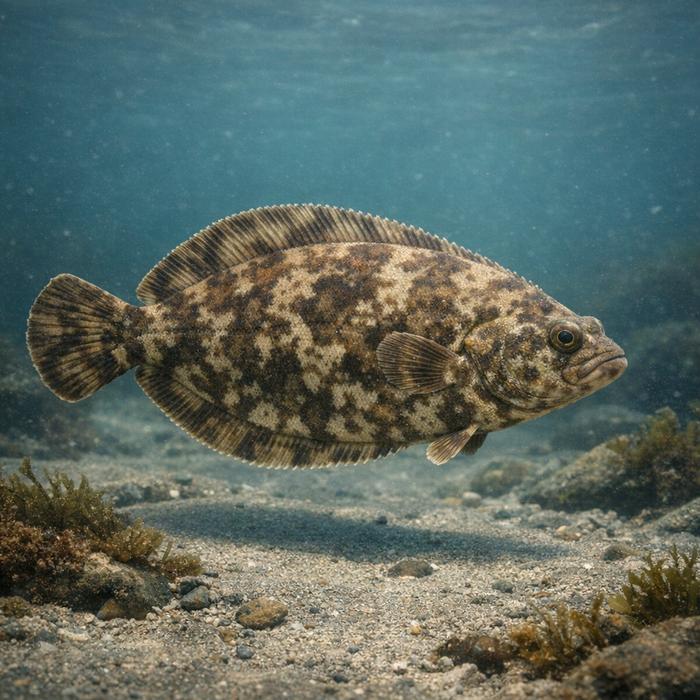
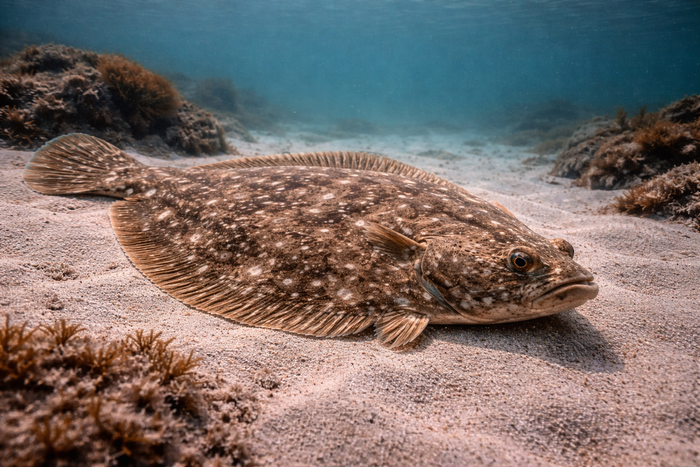
Start with the face. Young larvae initially have an eye on each side, like ordinary upright fish. During metamorphosis, the right eye migrates to the left side, producing the familiar left-eyed adult. The fish also changes its body orientation as it shifts toward life on the seabed. It does not hatch looking like a misplaced dinner plate; that arrangement develops later.
Then there is camouflage. The upper surface can change shade and pattern in response to its background. Experiments found something especially strange: covering the right eye prevented those background-matching changes, while covering the left eye did not. Both eyes end up upstairs, but they do not necessarily contribute equally to inspecting the floor.
Finally, this is a large-mouthed, sharp-toothed hunter, not a tiny-mouthed bottom grazer. Among Olive Flounder facts worth remembering, that combination of concealment and active pursuit explains far more than the flattened outline alone.
Habitat & Global Range
The species belongs to the northwestern Pacific, with a native distribution encompassing Japan, the Korean Peninsula, and neighboring Asian seas, extending north toward Sakhalin and the Kuril Islands. It is a marine bottom fish associated particularly with sandy and muddy substrates. Published depth accounts reach approximately 200 meters, although anglers also target it in shallow coastal surf.
Olive Flounder habitat is therefore more varied than a single strip of beach. Open sand, coastal bottom, and feeding areas near structural changes all matter. Shore anglers look for troughs, outgoing currents, and transitions around obstacles rather than treating every stretch of sand as identical.
Season also changes accessibility. In Japanese waters, fish commonly occupy deeper areas during winter and move shallower around spring and early-summer reproduction. That is a useful pattern, not a universal timetable for every coastline.
Behavior & Temperament
The Olive Flounder is an ambush predator with an escape clause: it can leave the ambush. Partly buried fish may expose little beyond the head, yet feeding individuals can swim upward into the water column and follow prey. Calling it sedentary misses the interesting part. Waiting is a hunting strategy, not evidence that the engine is broken.
Its early life is different again. Eggs and larvae spend a planktonic phase before juveniles settle into nursery habitat. Research on larvae shows that responses to light and salinity change during development, potentially helping their transport toward inshore grounds. The beach fish begins life negotiating water movement before it starts negotiating sand.
Ecological Importance
This predator links coastal prey populations with larger consumers and fisheries. Its nursery stage also ties successful recruitment to shallow coastal environments, making the condition of those areas relevant well beyond their appearance at low tide. Research on released and wild juveniles has examined how both use nursery grounds, highlighting that stocking fish does not eliminate the importance of habitat.
The species is commercially important in East Asia and supports substantial aquaculture activity. That dual identity matters: wild fish, hatchery releases, and farm production are connected management subjects, but they are not interchangeable measures of a healthy wild population.
Conservation & Environmental Pressures
The Olive Flounder is listed as Not Evaluated in the global conservation-status information consulted. That means no completed assessment in that listing, not a certificate saying everything is fine. Local stocks still require their own evidence and management.
Fishing pressure and stock enhancement have both shaped its management history. Hatchery juveniles have been released to bolster fisheries, while research has investigated survival and interactions with wild fish. Adding juveniles is not the same as guaranteeing that enough reach adulthood. Nursery conditions and available food remain part of the equation.
For recreational anglers, responsible harvest starts with the actual local rules. Check the jurisdiction, respect closures and access restrictions, and avoid assuming a famous fishery is an unrestricted one.
The FishyAF Take
The Olive Flounder deserves better than being dismissed as something flat that tastes good. Its appeal is the contradiction: nearly invisible when resting, thoroughly predatory when moving. This is stealth with teeth, not scenery.
Our take? Give the bottom more credit. Read the current, notice the changes, and stop assuming the most impressive cast is the most useful one. Approach the fishery as a puzzle rather than a casting-distance contest. The satisfying part is not merely catching a fish from apparently empty water. It is realizing that the water was never empty—you just had not learned where to look.