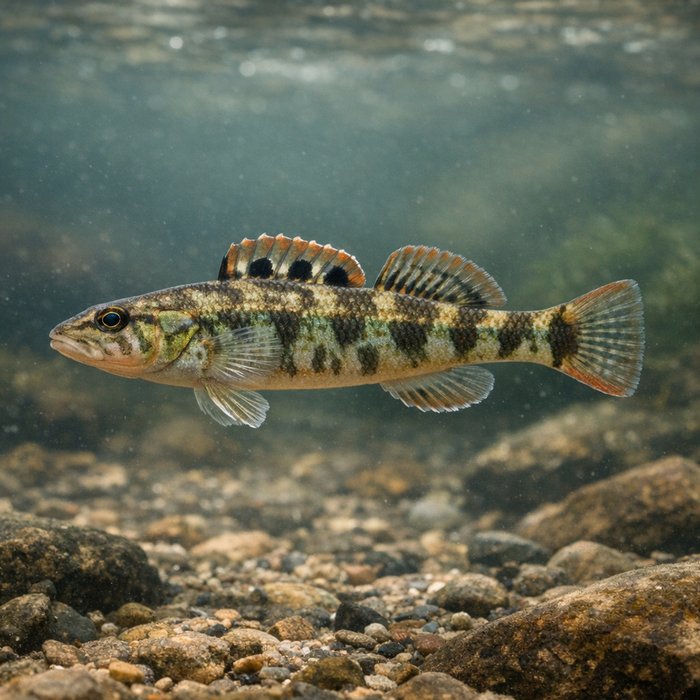
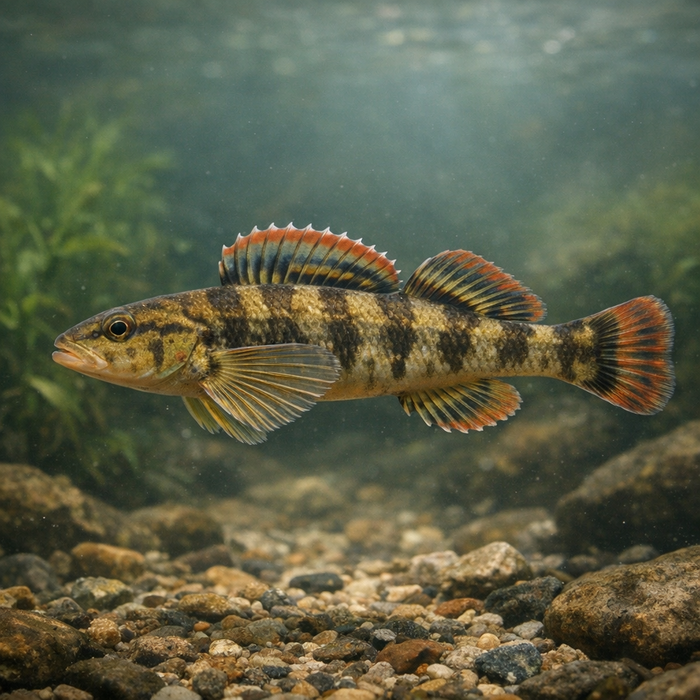
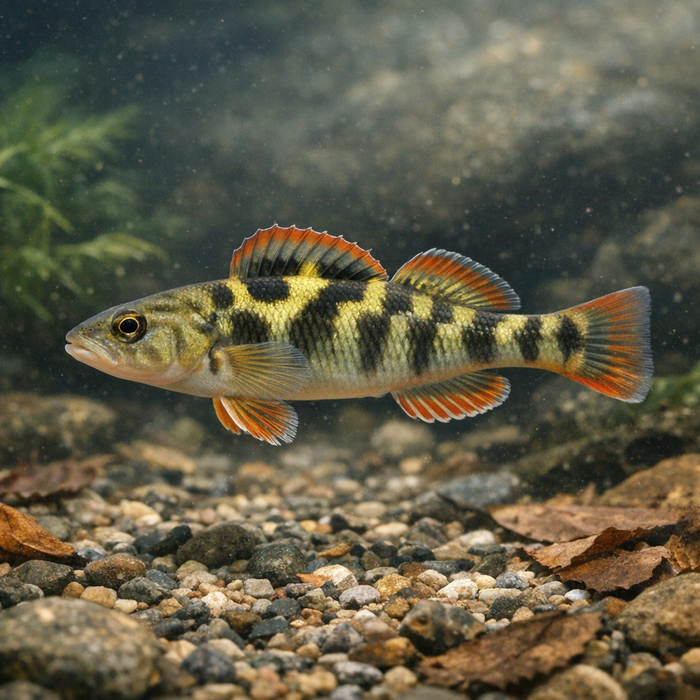
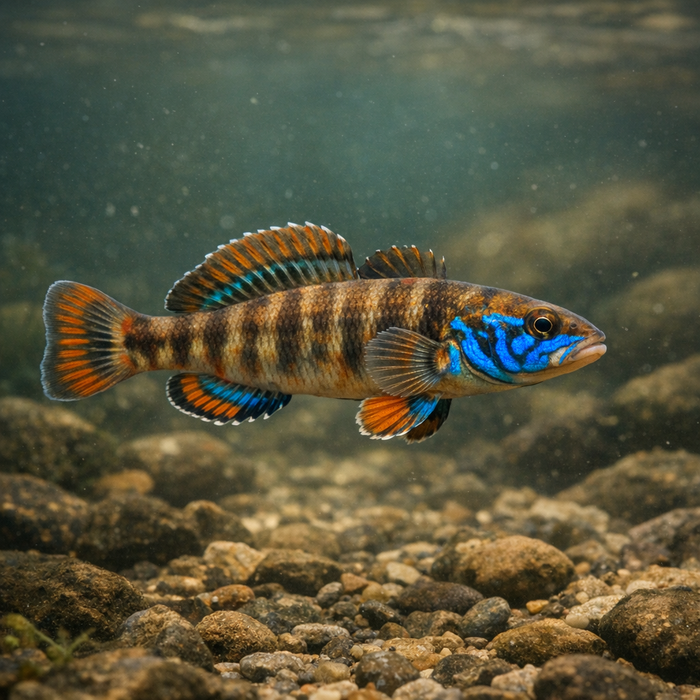
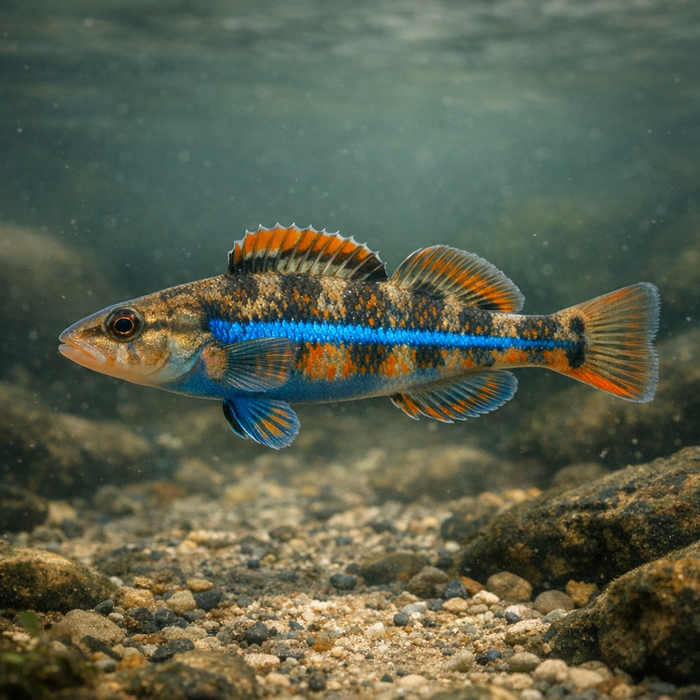
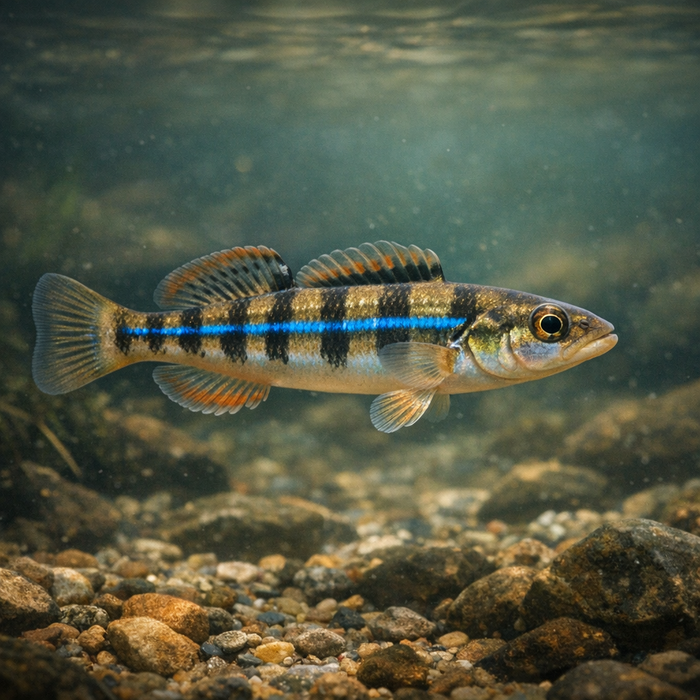
Stippled Darter (Etheostoma punctulatum): Speckled pocket-rocket built to glue itself to fast waterIntroductionThe stippled darter is the river's tiny speedster: all business, no float. It hugs the bottom like it's magnetic, launches in short bursts, and vanishes under a pebble before your brain registers the blur. Anglers who chase it aren't looking for drag-screaming runs; they want precision-the kind that turns a riffle the size of your doormat into a surgical playground. If you're hunting real Stippled darter facts, start here. This is the micro-sized gladiator of the current seam.What Makes the Stippled darter Unique?A few things make the stippled darter stand out. First, that signature peppered pattern-dark stippling scattered across tan to olive sides-breaks up its silhouette so well you can stare straight at one and never see it. Second, this fish practically said "no thanks" to buoyancy. With a reduced swim bladder and big, fanlike pectorals, it sits tight on cobble where other fish would pinwheel away. Third, its moves are all about economy: lightning micro-bursts to ambush a drifting nymph, then absolute stillness to avoid becoming lunch. For anglers, that means the game is stealth, not strength, and presentations must be dead-on.Habitat & Global RangeYou won't find the stippled darter cruising ponds or loitering in backwaters. Think clear, cool, well-oxygenated streams with gravel and cobble, especially riffles and fast runs. That's prime stippled darter habitat, and it's a niche they dominate. They wedge into micro-current breaks behind pebbles, settle into thin sheets of water that look unfishable, and use every contour of the streambed to their advantage. The range skews regional rather than continental, which keeps them a local obsession for anglers who like poking around Ozark-style creeks and similar systems. If your stream has clean stones, a steady push of current, and invertebrates tumbling through, you're in the right neighborhood.Behavior & TemperamentThe stippled darter is a minimalist predator. It doesn't sprint far; it doesn't chase long. It picks feeding lanes, watches for nymphs and micro-inverts tumbling by, and pounces with ruthless timing. Spawning comes with a bit more swagger-males darken up, claim the best lies in a riffle, and act like bouncers at a gravel nightclub. Outside of that, they're solitary operators. You might see a cluster in perfect habitat, but each fish stakes its own tight bubble. Surface feeding is pretty much off the table; everything here happens on the deck. Short windows of activity revolve around light, temperature, and flow, so if you're paying attention, you'll see a riffle "turn on" like a switch.Ecological ImportanceSmall but mighty, the stippled darter is a quality-control inspector for streams. Because it needs clean, well-oxygenated water and intact gravel, its presence hints that a watershed is doing something right. It's a workhorse link in the food web, turning drifting invertebrates into calories for bigger predators while also keeping certain bug populations in check. Flip it around and you'll see another truth: when silt smothers substrate, stormwater spikes, or pollution sneaks in, darters are among the first to blink out. Lose your stippled darter and you've probably lost a lot of other good things in that creek too.Conservation & Environmental PressuresOn paper, the stippled darter sits comfortably as a species, but that doesn't mean it's bulletproof. Fine sediment from poor land use clogs the spaces between stones where it feeds and spawns. Low summer flows and warmups squeeze oxygen and shrink habitat. Chemical hits-from herbicides to accidental spills-hammer small streams disproportionately. The good news: this fish doesn't need a massive river revival to thrive. Give it clear water, honest flows, stable banks, and riffles that aren't cemented with silt, and it rebounds.The FishyAF TakeThe stippled darter is proof that fishing isn't only about big. It's about precision, observation, and a weirdly satisfying kind of patience. You stalk a riffle like a heron, drop a nymph the size of an eyelash, and watch a two-inch fish make a move that would embarrass a tarpon for efficiency. If you crave a bite that rewards stealth over horsepower, the stippled darter is your teacher. Keep it simple: light line, tiny hooks, clean drifts, wet hands, quick release. Nail that, and you'll unlock a pocket-sized masterclass in current reading that will level up everything else you fish for.