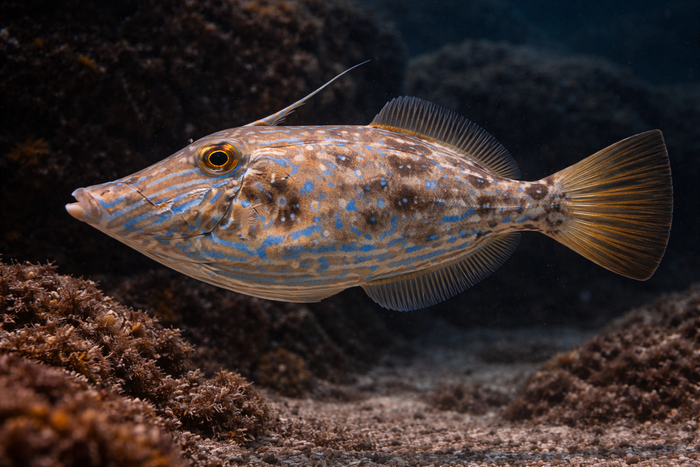
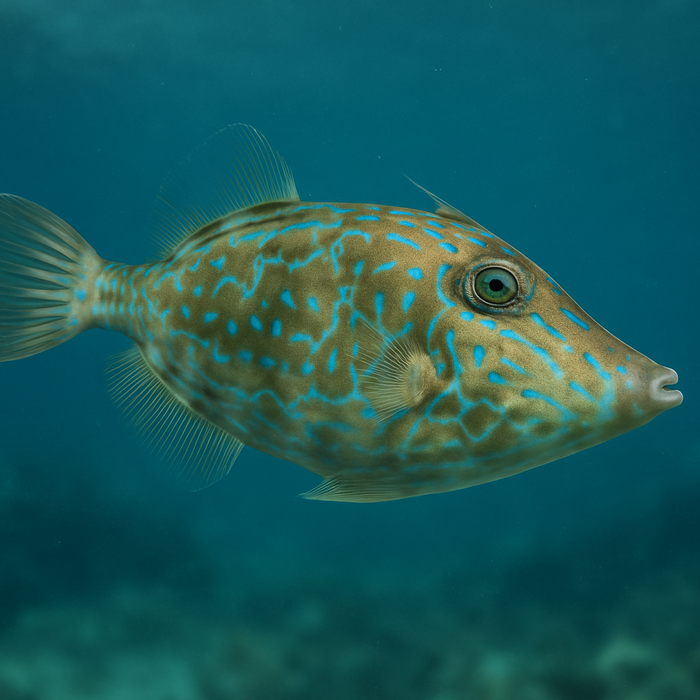
Unicorn Leatherjacket Filefish (Aluterus monoceros): A bold, big-nosed reef rider with stealth and sandpaper skinIntroductionThe unicorn leatherjacket filefish has the snout, the attitude, and the armor to stand out on any reef. It's not the most glamorous sportfish, but this long-faced filefish shows up where serious structure meets snack-size invertebrates. Anglers who pay attention to small details and tiny bites discover a quirky, satisfying target that rewards finesse over horsepower.What Makes the Unicorn leatherjacket filefish Unique?For starters, that profile. The elongated snout and a stout, trigger-like first dorsal spine give the unicorn leatherjacket filefish its namesake silhouette. That spine isn't decoration; it can lock to brace the fish in crevices like a living doorstop. Then there's the hide: a tough, abrasive skin that explains the leatherjacket moniker. Add rapid-fire camouflage changes and you get a stealth specialist that can blend from plain brown to dappled, reef-matching patterns in seconds. As Unicorn leatherjacket filefish facts go, here's a good one: juveniles spend months drifting with floating sargassum before settling on the reef, crossing shocking distances without burning a calorie on travel.Habitat & Global RangeIf you're mapping Unicorn leatherjacket filefish habitat, think warm, clear water and hard bottom. They haunt coral and rocky reefs, rubble fields, channel edges, and nearby seagrass beds from shallow flats to roughly 100 feet and beyond. Adults work the edges where current delivers a buffet of tunicates, sponges, and crustaceans. You'll spot singles or synchronized pairs cruising deliberate laps around coral heads, then hovering with those long dorsal and anal fins rippling like ribbons. Juveniles ride the weedlines offshore, blending into sargassum patches until they're big enough to join the inshore reef scene.Behavior & TemperamentThis species is no brawler. Hook one and you'll feel steady resistance instead of blistering runs. The real challenge happens before the hookset. Unicorn leatherjacket filefish pick with precision, snipping baits clean and ghosting off when leaders flash or weights clink. They're curious but wary, often tailing a bait for yards before committing. Light line, small hooks, and a quiet presentation matter. When spooked, they'll lock that spine and slide into structure, becoming a coral-colored door wedge you can't budge.Ecological ImportanceThe unicorn leatherjacket is part groundskeeper, part quality control. By clipping sponges, tunicates, and other encrusting invertebrates, it helps balance growth on reefs. That nipping creates micro-grazing pressure where corals and seagrass compete with fast-growing fouling organisms. Meanwhile, they're prey for larger predators, passing that benthic biomass up the food chain. Juveniles sheltered in sargassum transfer open-ocean energy to nearshore webs once they recruit to the reef.Conservation & Environmental PressuresThis fish isn't a headline conservation concern right now, but reefs are. Coral bleaching, coastal runoff, destructive gear, and habitat loss press on the neighborhoods unicorn leatherjackets rely on. They show up as bycatch in small-scale fisheries and, in some areas, enter local markets. Another wrinkle: ciguatera risk increases with size and locality, which can shift harvest behavior. Healthy reefs mean healthy filefish. Protect the structure and water quality, and these oddballs generally do fine.The FishyAF TakeThe unicorn leatherjacket filefish is the reef's sly minimalist: long nose, locked spine, quiet moves. Anglers who live for chaos might overlook it. But if you geek out on subtle bites, perfect leader angles, and fish that make you earn every nibble, this species is your jam. It's also a great litmus test for your stealth game. If you can fool a unicorn leatherjacket in skinny, sunny water, you're dialed for almost anything that pecks and vanishes. Not the loudest trophy, but definitely one you remember.