Wallago Catfish (Wallago attu): All Mouth, No Interest in Your Fingers
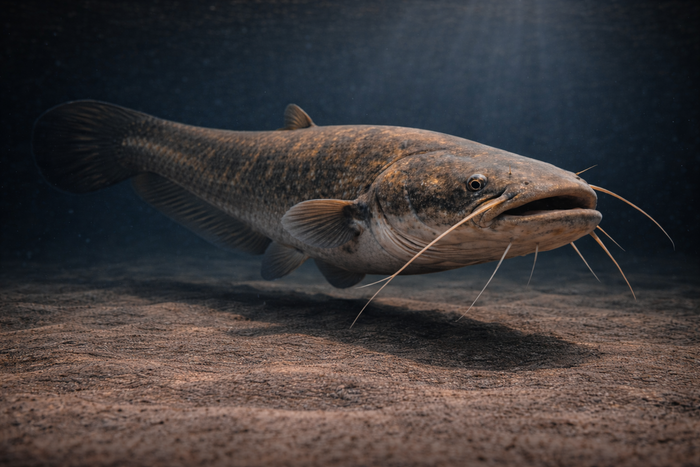
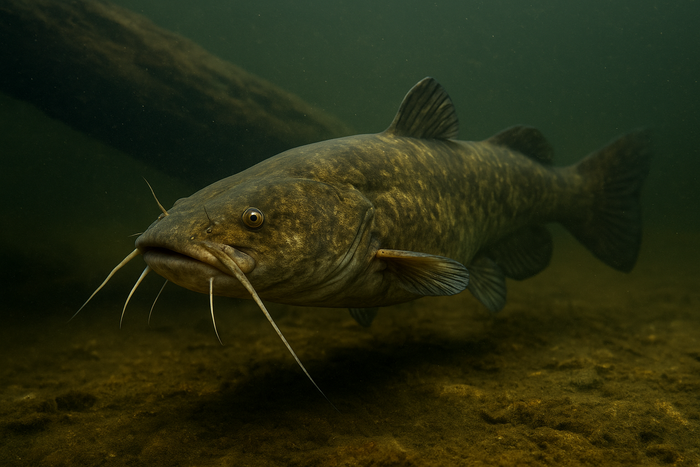
The Wallago Catfish looks like somebody stretched a predator around an oversized mouth and decided the proportions were close enough. Its elongated body, flattened head and deeply cut jaws give it an unmistakable silhouette. Those jaws carry serious teeth, so this is not a catfish to lip for a photograph. It belongs to the Siluridae family, but the familiar whiskers should not distract you from the business end.
For anglers, the appeal is straightforward: a freshwater predator worth targeting deliberately rather than treating as a lucky bycatch. The challenge is putting a bait where the fish actually lives, then having the equipment and handling plan ready when patience finally pays.
What Makes the Wallago Catfish Unique?
Start with the mouth. Its opening extends behind the eyes, making an already broad head look almost entirely devoted to swallowing. Beneath that appearance lies unusually specialized jaw construction, including an upper jaw partly suspended through a modified bone beneath the eye. This is not simply another large catfish with a generous appetite; its feeding anatomy is genuinely distinctive.
Then there is the fin arrangement. A small dorsal fin contrasts with an exceptionally long anal fin, while the longest barbels reach beyond the anal fin’s origin. These are useful identification features, not decorative extras. Among the most worthwhile Wallago Catfish facts is that recognizing the actual species matters more than believing whichever enormous weight accompanies an online photograph.
Habitat & Global Range
The Wallago Catfish occupies fresh waters across South and Southeast Asia. Its distribution includes major river systems of the Indian subcontinent and mainland Southeast Asia, with populations also occurring on Sumatra and Java. Within that broad range, it uses rivers, lakes, reservoirs and connected floodplain waters. Deep, slow water over mud or silt is particularly characteristic habitat.
Think in terms of connected features rather than one magic depth: a channel beside a quieter margin, a sheltered bank adjoining deeper water, or floodplain habitat linked to a river. Understanding Wallago Catfish habitat means reading the water’s layout before choosing where to park a bait. A promising-looking bank means little if your rig lands somewhere entirely different from the feature you intended to fish.
Behavior & Temperament
This is a nocturnal predator, although that does not mean daylight captures are impossible. In the Mekong, documented movements connect floodplain feeding areas with deeper river refuges as water levels change. Those movements are generally local rather than continent-spanning migrations. The fish follows seasonal opportunities, not an angler’s preferred calendar.
Its predatory streak starts early. Captive fry can become cannibalistic, creating substantial problems for hatchery production. Researchers have observed youngsters swimming among siblings and biting when opportunities arise. That is a more revealing glimpse of its temperament than the usual monster-fish mythology. The Wallago Catfish does not need invented aggression to be interesting; its documented early-life behavior is already fairly ruthless.
Ecological Importance
As a fish-eating predator, it participates in the transfer of energy from smaller aquatic animals into larger predators. Juveniles also consume insects and other invertebrates, so its ecological role changes as it grows. Calling it merely a bottom scavenger misses the point: this species is equipped to capture animal prey, not just investigate whatever settles into the mud.
It also connects river ecology with human livelihoods. In Manipur, where it is known as sareng, it is a valued culinary fish with cultural and economic importance. Work on captive breeding and farming reflects that demand. For anglers, this adds perspective: the same species pursued for a memorable catch may also represent food, income and a strong local attachment.
Conservation & Environmental Pressures
The Wallago Catfish is classified as Vulnerable. A fearsome mouth offers little protection from sustained harvest or deteriorating habitat. Conservation concerns include overexploitation, pollution and the loss or alteration of aquatic habitats. A species can occur across a large geographical area and still face serious pressure within individual waters. Widespread does not mean inexhaustible.
Responsible targeting starts before the first cast. Establish whether fishing is permitted, whether retention is allowed and whether the water has additional conservation restrictions. Where release is appropriate, prepare your landing equipment, long pliers and camera beforehand. The objective should be a controlled encounter, not an improvised wrestling match followed by a prolonged photography session.
The FishyAF Take
This is a fish for anglers who enjoy solving the problem before enjoying the photograph. Our approach is simple: sensible heavy tackle, a carefully placed fish bait and no heroic experiments with fingers near the mouth. Use the fishery’s rules as your starting point, not an obstacle to work around.
The Wallago Catfish deserves better than exaggerated dimensions and borrowed monster stories. Identify it properly. Fish for it intentionally. Handle it like you knew what you were doing before it arrived. An honest catch from a well-read piece of water is considerably more impressive than a suspicious weight and a terrible grip.