Eagle Ray (Myliobatis aquila): Wings Over the Sand, Crushing Plates Below
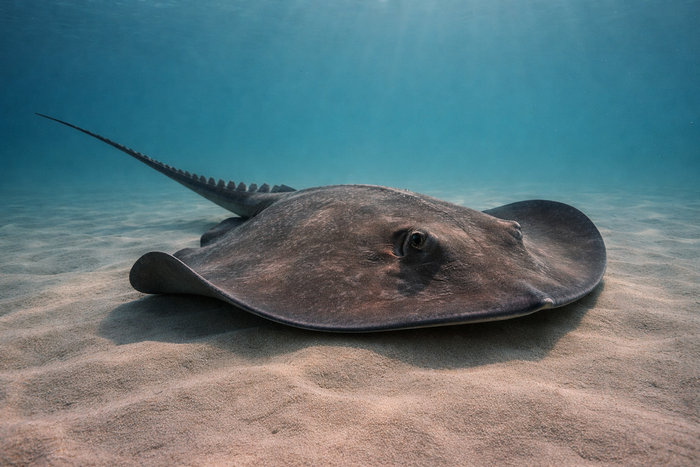
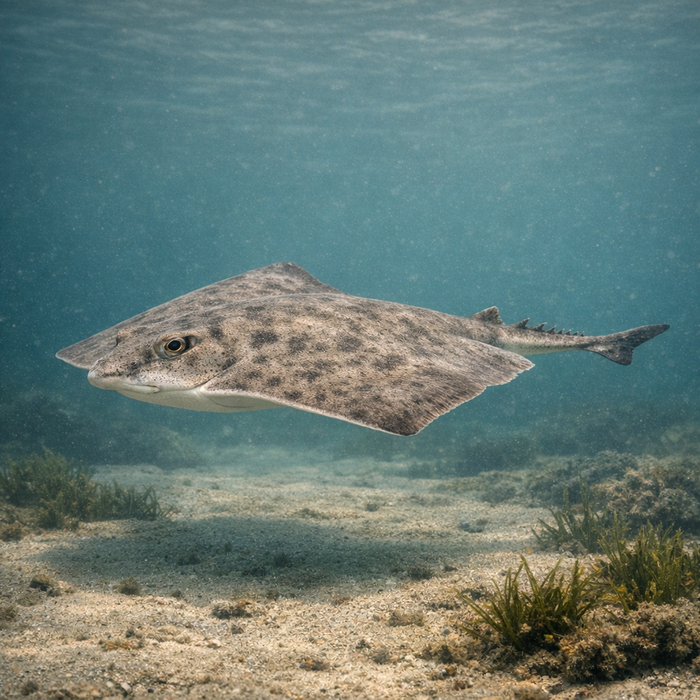
The Eagle Ray looks built for graceful cruising, then opens a mouth equipped for demolition. Beneath those broad wings sits a predator that tackles hard-shelled prey with flattened dental plates rather than a shark’s cutting teeth. It belongs to the family Myliobatidae, but this is not the spotted tropical ray that often steals the underwater-camera spotlight. Myliobatis aquila has a plain, dark upper surface, a pale underside, and a short, rounded snout. Elegant does not mean delicate.
For anglers, its story demands more than tackle talk. The species is globally Critically Endangered. Encounters deserve competent handling, minimal disturbance, and a release plan prepared before a bait enters the water. Knowing what you have hooked matters more than collecting another photograph.
What Makes the Eagle Ray Unique?
Three features define this fish: wings, crushing plates, and a disproportionately long tail. Its broad pectoral fins provide the winglike outline and oscillating swimming motion. Rather than relying on a conventional tail fin, it moves through the water with those enlarged fins. The slender tail has no caudal fin, and a defensive spine sits near its base. That spine deserves respect without turning the animal into a cartoon villain.
The mouth is equally distinctive. Typically arranged in seven rows, its plate-like teeth form a crushing surface suited to armored prey. Think shell-breaking equipment, not a rack of needles. The rounded snout and plain coloration also help separate this Eagle Ray from other rays carrying similar common names. Among useful Eagle Ray facts, correct identification is the one that prevents the most downstream nonsense.
Habitat & Global Range
Eagle Ray habitat centers on coastal water with sandy or muddy bottoms, including bays, lagoons, and estuaries. Its wider distribution runs through the eastern Atlantic and Mediterranean, around southern Africa, and into the western Indian Ocean, with records extending to Kenya. Those range boundaries describe occurrence, not guaranteed abundance. A species can occupy a large map while becoming scarce within it.
The familiar South African setting is warm-temperate Cape coastline, where sheltered embayments and soft-bottom shore grounds feature prominently. False Bay and Algoa Bay are documented research locations. Although anglers usually associate the fish with accessible coastal water, published records extend to 537 meters deep. Calling it exclusively a shallow-water ray would miss a substantial part of its capabilities.
Behavior & Temperament
The Eagle Ray combines bottom feeding with swimming above the seabed. Groups are well documented, and South African observations describe animals cruising just beneath the surface, sometimes showing their wings above it. Summer gatherings can be conspicuous. A cluster of visible rays, however, is not evidence that the wider population is healthy or that every individual is feeding.
Movement is more complicated than a neat seasonal migration arrow. Recent acoustic tracking in Algoa Bay found substantial local use alongside longer excursions by individual animals. Researchers are still resolving those patterns. The practical lesson is simple: yesterday’s sighting is useful information, not a reservation. Around people, the ray is not considered aggressive, but its tail spine makes careless handling a bad experiment.
Ecological Importance
This predator links the seabed’s smaller animals to larger marine food webs. Its documented prey include mollusks, crustaceans, worms, and small fishes. Feeding involves disturbing sediment to uncover food, so the fish interacts physically with the bottom rather than merely passing over it. That makes its presence part of the working life of coastal soft-bottom habitats.
The reproductive system adds another important dimension. Females produce live young, generally three to seven after a gestation of six to eight months. Developing embryos receive maternal nourishment beyond their initial yolk supply. These relatively small litters help explain why repeated fishing losses are difficult to replace; this is not a broadcast spawner releasing millions of eggs.
Conservation & Environmental Pressures
The Eagle Ray faces capture in trawls, nets, and recreational fisheries, alongside degradation of shallow coastal habitats. Schooling can amplify the problem when several animals enter fishing gear together. Its global assessment suspects a population reduction exceeding 80 percent over three generations. That figure describes the assessment’s inferred decline, not a precise census of every bay.
Release is necessary, but it is not a magic eraser. Gaffing, weighing, and rough handling are specifically identified concerns, while species-specific release mortality remains uncertain. Avoid lifting by the tail, dragging the animal for a photograph, or extending an encounter to satisfy curiosity. Protected areas, responsible fisheries management, and better movement data all matter beyond the individual catch.
The FishyAF Take
The Eagle Ray does not need a tougher reputation. It needs anglers who can tell the difference between impressive and expendable. Admire the wings. Respect the spine. If one takes your bait, make the encounter efficient and the release uneventful. Better still, appreciate a visible gathering without casting into it. The smartest flex here is restraint: knowing when an extraordinary fish deserves less attention from your hook, not more.