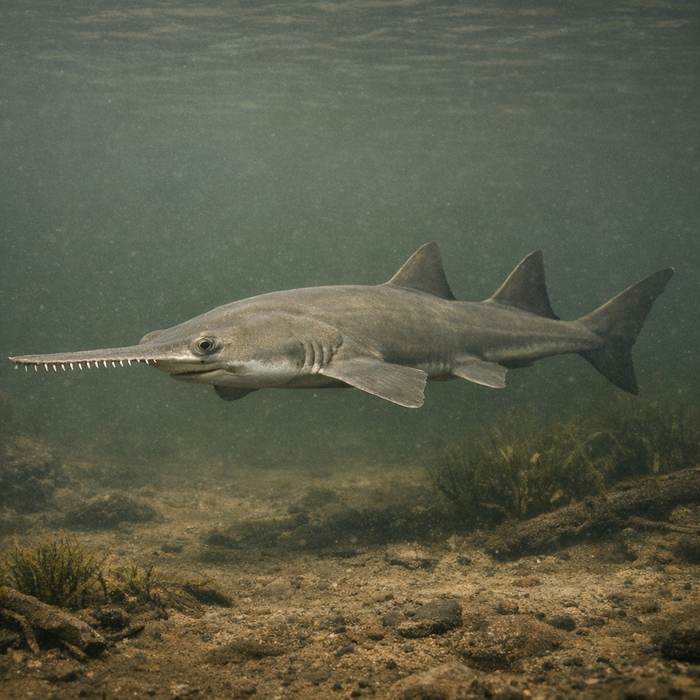
Large-Tooth Sawfish (Pristis perotteti): A Bold, Memorable Hook LineIntroductionThe large-tooth sawfish is a living fever dream of a fish: a massive ray wearing a chainsaw for a nose, cruising muddy water like a ghost. It isn't just rare. It's vanishingly rare, protected almost everywhere, and the sort of encounter that makes you forget what you were tying on. If you're after Large-tooth sawfish facts or curious about Large-tooth sawfish habitat, settle in. This is one of those creatures that rewires your idea of what a fish can be.What Makes the Large-tooth sawfish Unique?Start with the rostrum: a long, tooth-studded blade loaded with electroreceptors. That saw isn't for show; they whip it side to side to stun fish and stir crustaceans from the mud. Then there's the size. Mature large-tooth sawfish can eclipse most sharks, with heavy, armor-plated bodies and a rostrum that can be nearly a quarter of their length. Finally, this species blurs the salt-fresh line better than most "marine" fish. It can move from coastal shallows to far upstream in freshwater, shrugging at salinity swings other species can't handle. Note: many modern taxonomies consider Pristis perotteti a regional form of Pristis pristis, but anglers still encounter the name perotteti in literature.Habitat & Global RangeThe large-tooth sawfish plays the edges: turbid estuaries, mangrove creeks, river mouths, and low-gradient rivers. Think tea-colored water, tide-flushed backwaters, and soft bottoms loaded with life. They once roamed broadly across the tropical Western Atlantic, including the Gulf of Mexico, Caribbean, and northern South America, with historical records from West Africa as well. Today, sightings have thinned to a whisper. Where they remain, juvenile fish favor ultra-shallow nursery zones with tangled roots, while larger fish patrol deeper runs and channel edges.Behavior & TemperamentThis isn't a schooling speedster. Large-tooth sawfish are methodical bottom prowlers that can spike into mayhem when a meal shows up. The saw is both weapon and sensor, letting them feed effectively in chocolate-milk visibility. They spend lots of time tight to bottom, often near structure, and use spiracles to pull in water while partially buried. Hook one and you'll discover a freight-train body with leverage for days. They don't tail-walk. They just pull.Ecological ImportanceIf estuaries had bouncers, the large-tooth sawfish would be one of them. Apex-level, slow-growing, and habitat-connected, they stabilize food webs by pruning mid-level predators and recycling nutrients across salt-fresh boundaries. Their presence signals healthy, connected coastal systems where mangroves still do their job and rivers still carry seasonal pulses of freshwater.Conservation & Environmental PressuresThe big villains: entanglement in gillnets and trawls, habitat loss in mangroves and estuaries, and demand for rostra and fins. Being slow to mature with few pups per litter doesn't help. The result is a Critically Endangered status and strong protections throughout much of their range. Many countries ban take, possession, and even targeted fishing. Responsible handling when accidentally hooked is everything: keep them in the water, cut the leader as close to the hook as safely possible, and report sightings when requested by local authorities.The FishyAF TakeThe large-tooth sawfish is the fish you brag about without a photo and nobody doubts you. It's that mythical. For anglers, the play isn't chasing a statistic. It's being in the right kind of water and respecting what shows up. If you ever connect, you've already won. The best Large-tooth sawfish habitat is the same habitat we should be fighting to protect: living mangroves, breathing estuaries, and rivers that still flow on their own terms.