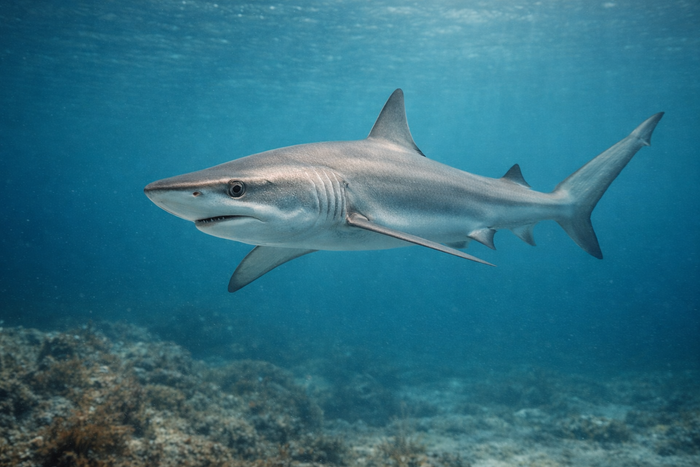
Milk Shark (Rhizoprionodon acutus): Small Shark, Complicated Family Life
The Milk Shark does not need heavyweight proportions to deserve your attention. This compact coastal predator belongs to the requiem shark family, yet its usual size puts it within reach of sensible surf tackle rather than fighting chairs and enormous reels. The guide’s typical range is 31.5–43.3 inches and 3–9 pounds: enough shark to make identification, tackle choice and handling matter, without turning every encounter into an expedition.
Its name sounds suspiciously gentle. The animal behind it is more interesting than that: a fish-eating hunter with regional differences in reproduction, a surprisingly elaborate maternity system and a conservation story that deserves better than “there are plenty around.”
What Makes the Milk Shark Unique?
Among the most memorable Milk Shark facts is what happens before birth. Females nourish developing young through a yolk-sac placenta, rather than simply releasing eggs. Research in the Gulf of Suez also found one functional ovary alongside two functional uteri, with egg development continuing during pregnancy. That is a busy reproductive schedule packed into a relatively small shark.
The details change geographically. Senegalese females carried embryos in separate uterine chambers, while research in Oman recorded considerably more female embryos than males. Those findings describe particular study populations, not a universal rulebook. This species is a useful reminder that a widespread shark can have distinctly local biology.
Habitat & Global Range
Milk Shark habitat centers on coastal and continental-shelf waters, including sandy beaches and surf. Its distribution spans parts of the eastern Atlantic along Africa and much of the Indian Ocean into the western Pacific, including northern Australia. That is a substantial range, but it does not make every warm beach equally productive.
Depth records extend from the surfline to roughly 200 meters, so this is not exclusively a beach shark. For anglers, accessible sandy shallows remain the relevant starting point. The Milk Shark also uses vegetated coastal habitat: research in Western Australia found juveniles associated strongly with seagrass nursery areas. Sand gets the attention; seagrass deserves some credit too.
Behavior & Temperament
Think working coastal predator, not cinematic villain. Diet research off Senegal found bony fishes overwhelmingly dominant by a measure of dietary importance, while work off Gujarat also documented a fish-centered diet. These are feeding studies, not bait trials, but they provide a sound biological basis for choosing fresh fish rather than some elaborate secret mixture.
The Milk Shark should still be treated as a shark when hooked. Small size is not permission to put fingers near its mouth or wrestle it for photographs. Approach the encounter with controlled pressure and a release plan. Keep unnecessary handling out of the routine, and never lift a released shark by its tail or grip it over the gills.
Ecological Importance
The Milk Shark occupies a middle position in the coastal food web: it consumes smaller animals and is itself eaten by larger sharks. That makes it more than a miniature version of a top predator. Its role connects prey communities with bigger hunters, placing it within a network rather than on an imaginary ladder with sharks permanently at the top.
Nursery habitat adds another layer. In Western Australia, shallow coastal waters supported young of this and several other shark species, with habitat use differing among them. A stretch of seagrass can therefore be more than background scenery beneath your bait. It can be part of the infrastructure supporting the next generation of coastal predators.
Conservation & Environmental Pressures
Globally, this species is assessed as Vulnerable. Australian assessments present a more favorable regional picture, reflecting managed fisheries and different fishing pressures. Both statements can be true. A regional population doing relatively well does not erase problems elsewhere, and a global threat category does not describe every local population with equal precision.
Fishing pressure is central to the concern. This shark occurs in commercial and small-scale catches, including gillnet and trawl fisheries. Australian research summaries also warn that being discarded does not necessarily mean surviving. For recreational anglers, release should be an actual handling objective, not merely the final word in a photograph caption.
The FishyAF Take
The Milk Shark deserves better than being dismissed as the little shark that interrupted a more prestigious fishing trip. Its appeal is not brute size. It is the opportunity to pay attention: recognize the species, understand the habitat and make a clean decision about what happens next.
Use tackle that finishes the job efficiently, not equipment chosen to make a small fish feel enormous. Have your release tools ready before the bite. Get your photograph without turning it into a production. The impressive part is not proving you can overpower a coastal shark. It is showing that you can catch one without leaving your judgment somewhere back in the parking lot.