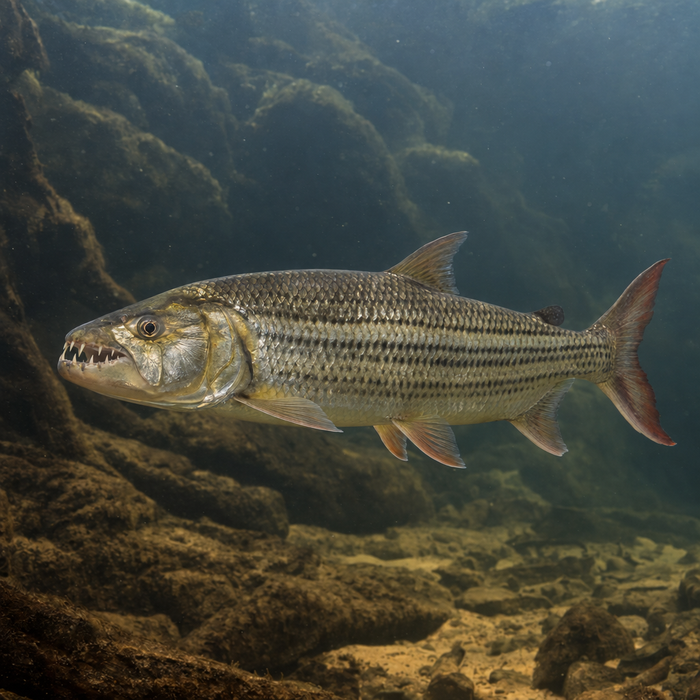
Nile Perch (Lates niloticus): The Freshwater Heavyweight That Rewrote a Lake
Some fish test your knots. Nile Perch can test the entire idea that your tackle was heavy enough. This African freshwater predator combines serious bulk, a cavernous mouth, and the kind of sustained power that makes an ordinary fishing outfit look optimistic. Its reputation reaches beyond trophy photographs: it supports major fisheries and became central to one of freshwater ecology’s most consequential species introductions. Big fish, big business, big complications. Understanding this species means looking past the impressive jaw and recognizing an animal capable of changing both a fishing trip and a food web.
What Makes the Nile Perch Unique?
Start with scale. Published biological references give maximum dimensions around two meters and 200 kilograms, although those figures are not equivalent to a certified rod-and-reel record. the typical FishyAF size bracket of 36–40 inches and 20–30 pounds describes a much more approachable angling fish, not the upper ceiling. Even at that size, this is no casual ultralight assignment.
Then there is reproductive output. Large females can release millions of eggs, with published estimates reaching roughly 16 million per breeding cycle. Producing enormous numbers does not mean enormous numbers survive, but it helps explain the species’ population potential. Finally, despite the familiar name, Nile Perch belongs to Latidae, the family containing barramundi, rather than the true-perch family Percidae. The name sounds ordinary. The biology is anything but.
Habitat & Global Range
Nile Perch habitat centers on large African lakes and river systems, including the Nile and several major West African basins. Native populations occur in waters such as Lake Albert and Lake Turkana; Lake Victoria’s population resulted from introduction. That distinction matters. A predator occupying its historical range and the same predator placed among unfamiliar prey can have very different ecological consequences.
For anglers, the listed destinations includes Lake Nasser, the Victoria Nile below Murchison Falls, Lake Victoria, Lake Albert, and Lake Turkana. Adults often occupy deeper water, while young fish use shallow nursery areas. Depth alone is not the answer: oxygen availability helps determine usable habitat. A huge lake is not one giant fishing spot, and the deepest hole is not automatically the best one.
Behavior & Temperament
Nile Perch is an apex predator, but its menu and hunting opportunities change with size and location. In Lake Victoria, documented prey include cichlids, small schooling fish, freshwater prawns, and younger members of its own species. Cannibalism is part of the story, not an angler’s exaggeration.
On the river, current edges, bends, and eddies give anglers places to start rather than reasons to cast blindly into the strongest flow. Documented lure fishing below Murchison Falls has produced bites beside the main current and around submerged structure. Hooked fish can shake their heads, use rocks against tackle, and make powerful runs. The useful lesson is simple: finding feeding water and protecting your connection matter as much as owning a large reel.
Ecological Importance
Few Nile Perch facts carry more weight than its impact after introduction to Lake Victoria. Its expansion helped drive dramatic declines among endemic haplochromine cichlids through predation and competition. Other environmental pressures also affected the lake, so blaming every change on one predator would oversimplify a complicated ecosystem. Nevertheless, its arrival profoundly altered the fish community.
The economic picture is equally substantial. Commercial catches feed processing, transport, export, and local markets. Those industries created income and employment, while export demand also changed access to affordable fish for shoreline communities. Calling this species simply a monster or simply a valuable resource misses the point. It can be both a livelihood and an ecological disruption, depending on the water and whose interests you are considering.
Conservation & Environmental Pressures
Nile Perch is globally assessed as Least Concern. That does not mean every population is healthy, every fishery is sustainable, or giant adults are inexhaustible. Fishing pressure can change local abundance and size structure even when a widespread species remains secure overall. Published fisheries references identify overharvesting as a concern.
Environmental conditions add another layer. Research in Uganda shows that temperature and dissolved oxygen influence the species’ physiology and habitat opportunities. Low-oxygen wetlands can also provide some indigenous fishes refuge from this comparatively oxygen-sensitive predator. Conservation therefore requires attention to whole habitats, not just the headline fish. Responsible angling should follow local retention rules, minimize handling, and avoid moving fish or live bait between waters. A successful introduction is not necessarily a good one.
The FishyAF Take
Nile Perch deserves its trophy reputation without needing inflated weights or guaranteed-monster marketing. Bring suitable tackle, respect the guide’s local knowledge, and treat every abrasion point as a potential expensive lesson. This is advanced fishing because preparation and judgment matter, not because buying the heaviest rod magically makes you ready.
Our take: chase the fish, not the mythology. Appreciate the fight, understand the fishery, and remember that an impressive predator does not automatically belong everywhere it can survive. The best trophy story ends with sound decisions, an intact ecosystem, and no need to add imaginary pounds.