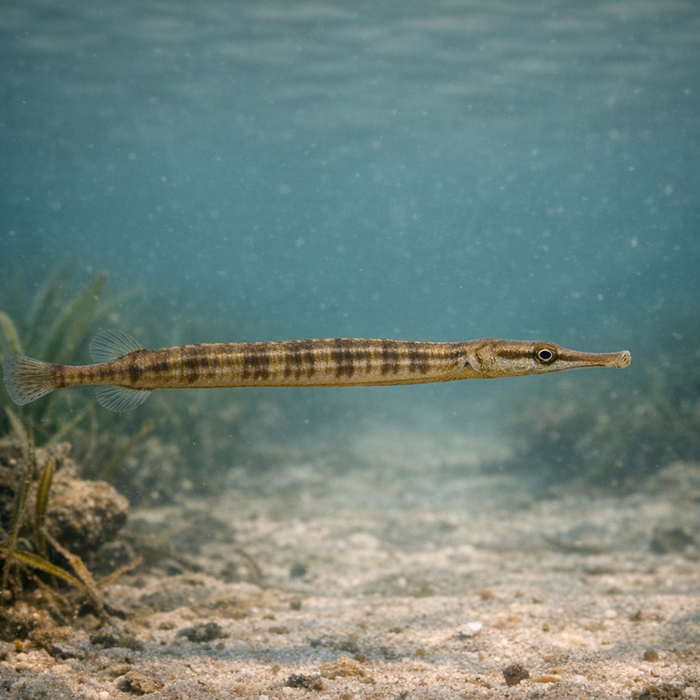
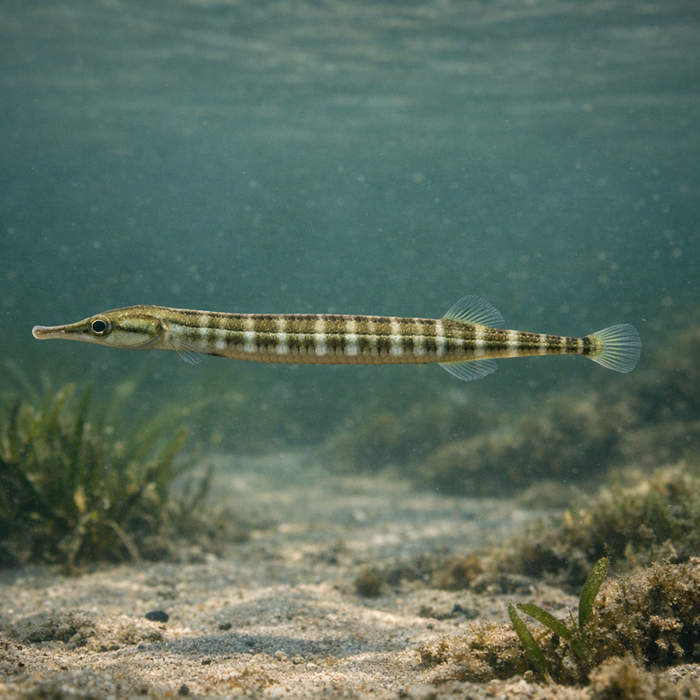
Sargassum Pipefish (Syngnathus pelagicus): The Weedline Ninja You Never Knew You SawIntroductionThe Sargassum pipefish is that pencil-thin phantom riding the golden rafts of Sargassum you've glassed past a hundred times without noticing. It's not built for speed, fame, or fillets. It's built for vanishing. Among the drifting weed, it's a master of stillness and suction, sipping tiny crustaceans like a straw in a smoothie. For anglers who love the odd and the overlooked, the Sargassum pipefish is a stealthy little marvel.What Makes the Sargassum Pipefish Unique?Start with the parenting: like its seahorse cousins, the male Sargassum pipefish broods the eggs. He carries the clutch in a protective belly pouch until fully formed juveniles are ready to go. Then there's the body plan: armored rings and a long, straw-like snout that delivers lightning vacuum strikes without telegraphing a move. And of course, the camouflage. The Sargassum pipefish wears the weed-mottled browns and olives, sometimes with delicate skin filaments-blending into fronds so convincingly that gulls, mahi, and even anglers swing right past.Habitat & Global RangeIf you're thinking Sargassum pipefish habitat, think surface highways. Syngnathus pelagicus spends its life at the top few feet of bluewater, clinging to or shadowing floating Sargassum mats. Convergence lines, rips, and offshore slicks act like conveyer belts, corralling everything from baitfish to trash. The pipefish rides that conveyor, sometimes drifting into coastal eddies, passes, and marinas after storms push weed inshore. Its range is broad and dynamic because the weed moves; where the mats go, the fish go. That can mean clear, cobalt highways one week and an empty ocean the next.Behavior & TemperamentPicture a twig pretending to be a twig. The Sargassum pipefish holds tight to fronds, bodies angled like stems, pivoting with every puff of wind and surface chop. It doesn't chase. It doesn't lunge. It pins prey with a quick head flick and inhales through the snout. They're social enough to cluster, but not schooling in tight formations. Spook them and they don't bolt far; they simply rotate, re-camouflage, and become seaweed again. Hooking them is a precision game; the mouth is tiny and the strike is subtle. Think sight fishing, not blind casting.Ecological ImportanceThe Sargassum pipefish is part of the floating-reef community that makes weedlines so electric. By grazing microcrustaceans, it recycles energy into a form that larger predators eventually cash in on. Its presence signals a healthy raft: zooplankton, mysids, shrimp, juvenile jacks, flyingfish, and the occasional ambush artist. Those mats are nurseries and buffets rolled into one, and the pipefish is an elegant little cog that keeps it spinning.Conservation & Environmental PressuresDrifting Sargassum is both lifeline and liability. Changes in ocean currents, temperature, and nutrient loads can amplify or crash weed blooms. Heavy wind can scatter mats overnight. Plastic collects in the same lines, tangling fish and compromising habitat. While the Sargassum pipefish isn't a headline species, it rides a headline habitat. If the rafts degrade, so does the whole floating community. Harvest pressure is minimal compared to gamefish, but aquarium demand and incidental capture do exist. Keeping mats intact and water clean is the real conservation play here.The FishyAF TakeThe Sargassum pipefish is the ultimate flex for anglers who appreciate patience and detail. It's not a grip-and-grin fish; it's a story fish. Spot the weedline, spot the shape, line up a speck-sized offering, and watch nothing happen-until suddenly everything happens. Of all the Sargassum pipefish facts you'll remember, hang on to this one: it teaches you to see. And once you learn to see at that scale, every offshore rip becomes a living puzzle, not just a highway to the next dorado.