Spot-tail Shark (Carcharhinus sorrah): The Tail Spot Is a Clue, Not the Whole Identification
The Spot-tail Shark comes with a conspicuous black tail marking, but identifying it takes more than spotting some dark paint. Several coastal sharks wear black-tipped fins, and this one deserves better than being filed under “probably a blacktip.” It is a compact tropical predator associated with continental shelves and reefs, built around a slender body and a mouthful of serrated teeth. For anglers, the appeal is not monster-shark theatre. It is learning to recognize a distinctive coastal species and approaching it with appropriate bait tackle, accurate identification, and a sensible release plan.
What Makes the Spot-tail Shark Unique?
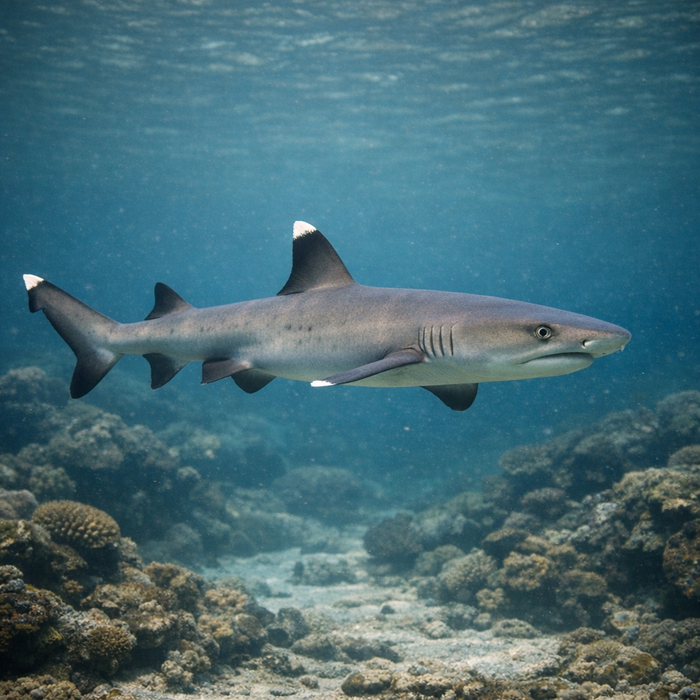
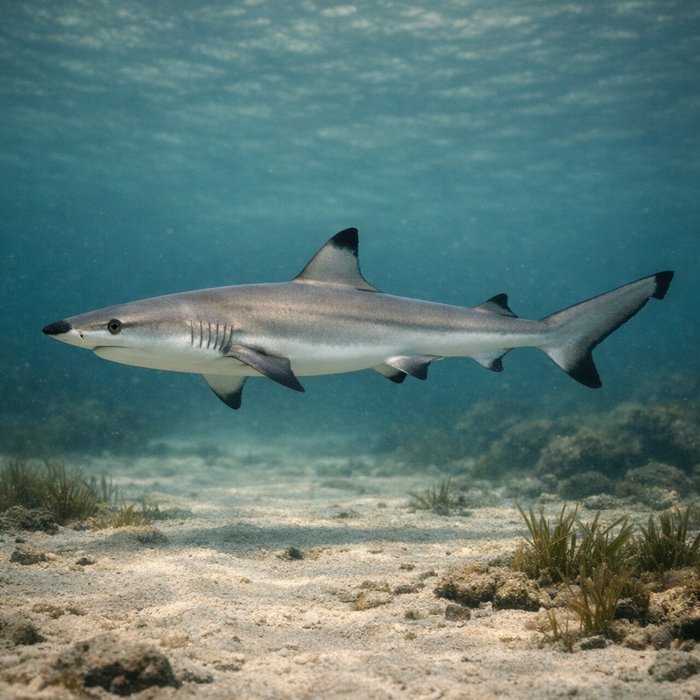
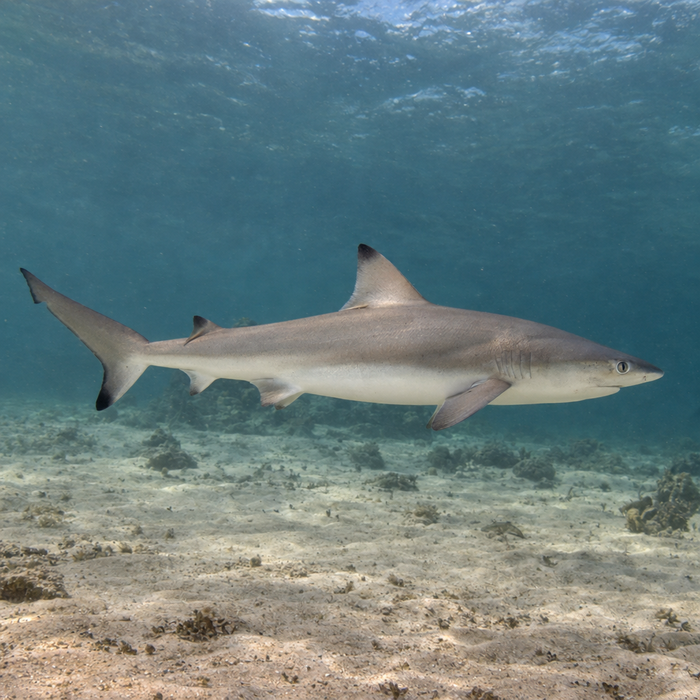
Start with the marking that earns the name: a prominent black patch on the lower lobe of the tail. Dark tips also mark the pectoral fins and second dorsal fin. The first dorsal generally carries a much narrower dark edge rather than the same conspicuous black cap. That distribution matters more than any single dark fin.
Two additional features help complete the picture. A ridge runs between the dorsal fins, while the second dorsal is unusually low, with an elongated trailing tip. Together, these details help separate the Spot-tail Shark from similar-looking coastal relatives. Fresh specimens may also show a golden-brown sheen around the side of the head. These are useful Spot-tail Shark facts because they turn identification into a combination of features, not a dockside guessing contest. Black tips alone do not settle the argument.
Habitat & Global Range
Its distribution spans the tropical Indo-West Pacific, including the Indian Ocean, Southeast Asia, and northern Australia. It occupies continental and island shelves, often around coral reefs, but reefs are not its exclusive address. Open coastal shelf habitat also belongs in the picture.
Spot-tail Shark habitat extends from very shallow coastal water to at least 140 metres. That is a biological depth range, not an instruction to fish the deepest available water. For practical planning, suitable coastal shelf and reef-margin habitat matters more than chasing a maximum-depth figure. Northern Australian tagging work found both relatively local movements and journeys exceeding 1,000 kilometres, so neither “permanent reef resident” nor “constant long-distance migrant” tells the whole story.
Behavior & Temperament
The Spot-tail Shark feeds chiefly on small bony fishes, with cephalopods and crustaceans also recorded. Its menu supports a straightforward bait-fishing approach, although diet information does not establish a scientifically proven favourite bait. Fresh fish presented near suitable habitat is a practical starting point, not a secret handshake.
Reproduction is more revealing than its modest dimensions suggest. Females bear live young supported by a yolk-sac placenta. Australian accounts describe roughly ten months of gestation and annual breeding, with litters averaging about three pups. Newborns occupy shallower water than adults. That makes shallow coastal habitat more than convenient fishing ground: it can be part of the species’ early-life support system.
Ecological Importance
This is a working coastal predator, not simply an occasional shark-shaped interruption to a reef-fishing session. By consuming fishes and other marine animals, it participates in the food-web connections linking reef-associated and coastal shelf communities. That does not justify claiming it single-handedly keeps a reef healthy; the defensible point is that it belongs to the system’s predator community.
The Spot-tail Shark also illustrates why small sharks deserve attention. Fisheries encounter it regularly, and both juveniles and adults are exposed to capture. Conservation cannot sensibly focus only on the biggest fins or the species that get the documentary soundtrack.
Conservation & Environmental Pressures
The global conservation status is Near Threatened. Coastal distribution brings the species into contact with industrial and small-scale fisheries, where it is both targeted and taken incidentally. Its meat and other products are utilized, so fishing pressure is not limited to recreational encounters. Relatively productive biology offers some resilience, but resilience is not an unlimited withdrawal facility.
Regional conditions matter. The northern Australian stock was assessed as sustainable in the 2023 stock report, while the global assessment remains Near Threatened. Those findings describe different geographic scales and are not contradictory. For anglers, the useful response is local: check current rules, avoid unnecessary handling, and do not assume a familiar-looking coastal shark is automatically legal to retain.
The FishyAF Take
The Spot-tail Shark is a good test of whether you actually enjoy fishing or just enjoy announcing that you caught a shark. The interesting part is the detail: knowing which tail lobe carries the mark, checking the dorsal ridge, choosing suitable tackle, and having the release equipment ready before the bite. That is a more satisfying standard than a rushed photograph and a confident wrong name.
Our take: fish deliberately, identify carefully, and make a clean release the default ambition. Use tackle that shortens the encounter rather than stretching it for entertainment, and keep the shark in the water whenever practical. A well-managed encounter beats a dramatic mishandling every time.