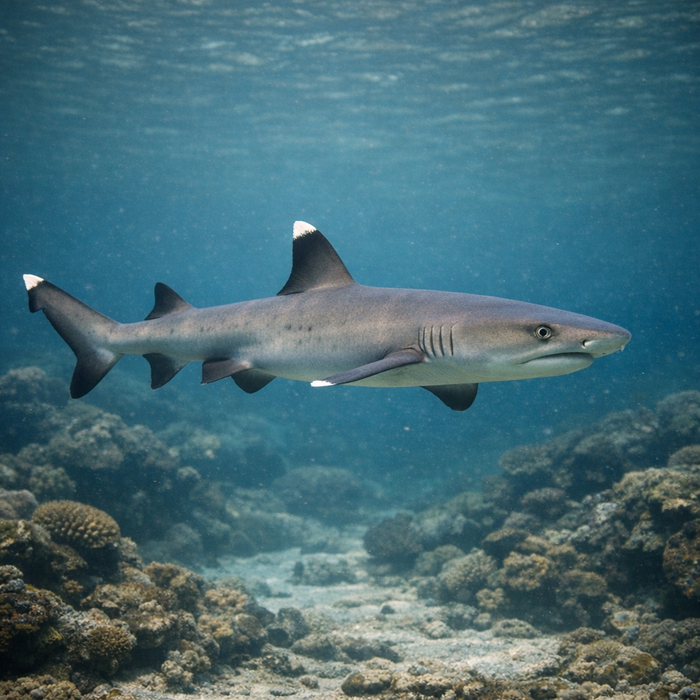
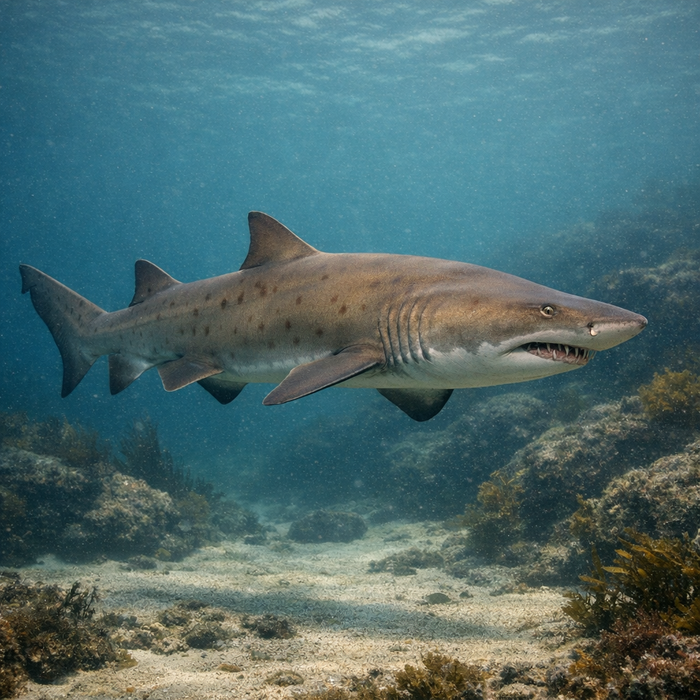
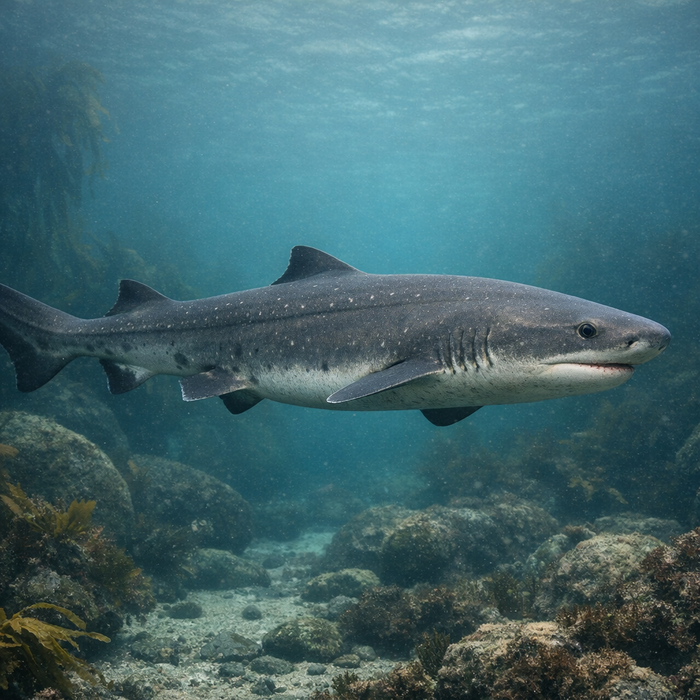
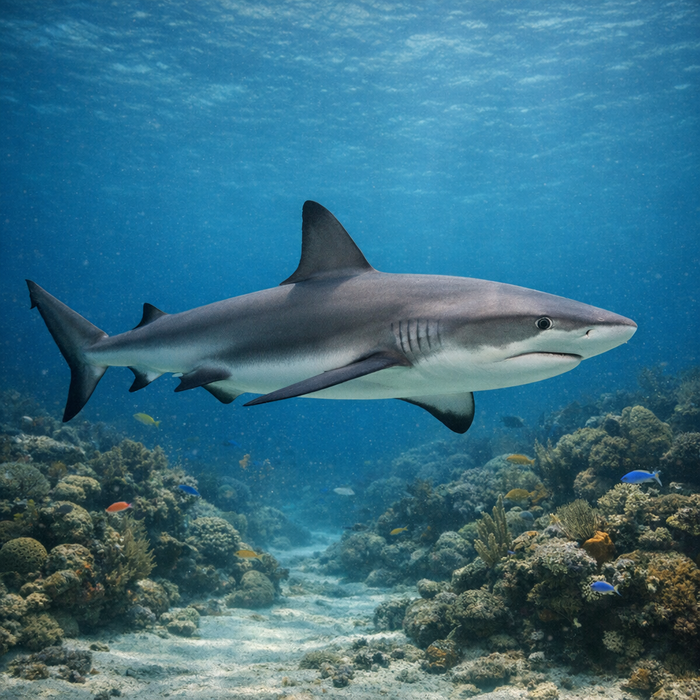
Zebra Shark (Stegostoma tigrinum): Born in Stripes, Grown into Spots, Built for the Reef
The Zebra Shark pulls off a wardrobe change most fish cannot touch: striped youngster, spotted adult. That transformation is only the opening act. Behind the relaxed appearance sits a specialized bottom predator with a remarkably long tail and a talent for working through reef crevices. It is an impressive animal without needing the usual shark-movie nonsense.
For anglers, the important distinction comes early: this is not an established recreational target species. FishyAF lists no verified species-specific tackle, bait program, or target fishery. Understanding this shark means knowing what it does underwater, not inventing a rig because somebody noticed it has teeth.
What Makes the Zebra Shark Unique?
Start with the pattern. Young animals wear pale bands against a dark background; growth gradually replaces that look with dark spots on a lighter body. The name describes the juvenile, not the adult most divers recognize. Add prominent lengthwise body ridges and a tail approaching half the animal's total length, and the silhouette becomes unmistakable. This is not simply another gray shark with different paint.
Then comes one of the strangest Zebra Shark facts: captive females have produced offspring without fertilization. Researchers genetically confirmed one female switching from sexual reproduction to parthenogenesis after separation from a male. That is extraordinary reproductive flexibility, not evidence that males are generally unnecessary or that depleted populations can rebuild themselves without help. Biology occasionally gets weird; conservation still has to do the work.
Habitat & Global Range
Zebra Shark habitat centers on warm coastal seas, especially coral and rocky reefs with nearby sand. Its Indo-West Pacific distribution connects the Indian Ocean with Southeast Asia, northern Australia, and parts of the western Pacific. Australian records extend around the tropical north and down the eastern coast into New South Wales. These are marine shelf environments, not an open-ocean hunting circuit.
The useful picture is reef structure beside open bottom: places to rest, shelter, and forage. Documented habitat includes depths of at least 62 meters, although many observations come from much shallower water. That depth figure describes recorded occurrence, not a recommended fishing depth. A distribution map shows where an animal belongs; it does not automatically identify somewhere anglers should target it.
Behavior & Temperament
The Zebra Shark commonly rests on the bottom during daylight and becomes more active at night. Large openings behind the eyes, called spiracles, help it circulate water over its gills while stationary. It does not need to spend every moment swimming to keep breathing. Resting individuals may face into the current, making water movement work in their favor. Efficient, rather than lazy.
Its flexible body lets it investigate tight reef spaces, while fleshy barbels help locate food. Mollusks are important prey, alongside crustaceans and small fishes. Its generally placid reputation should never become permission to grab, ride, corner, or otherwise bother it. A resting shark is occupied with being a shark, not volunteering for an encounter.
Ecological Importance
The Zebra Shark occupies a bottom-feeding predator role, consuming animals associated with reefs and adjacent seabeds. That places it within the food web linking benthic invertebrates, small fishes, and larger predators. It is not necessary to promote it into an all-powerful apex enforcer to explain why it matters. Its actual feeding ecology is interesting enough.
There is a useful lesson here for anyone who spends time on reefs: ecological importance is not measured by aggression. An animal can spend daylight parked on sand and still participate in the transfers of energy that sustain a marine community. Protecting the whole habitat makes more sense than valuing only the fish that smash a surface lure.
Conservation & Environmental Pressures
The Zebra Shark is globally Endangered. Fishing pressure and habitat degradation are central concerns, but conditions differ across its range. Australian assessments describe substantially lower fishing impacts than those affecting many populations elsewhere. Local abundance therefore should not be mistaken for global security. Seeing several sharks on one reef tells you about that reef, not the entire species.
Site attachment adds another concern: animals that repeatedly use particular areas can become vulnerable to localized depletion. Coastal fisheries overlap their habitat, and captures occur in several gear types. Protection needs to account for both the sharks and the places they repeatedly use. There is no contradiction between a wide geographic range and serious losses within it.
The FishyAF Take
The Zebra Shark does not need a fabricated trophy fishery to earn a place in an angler's head. Neither does every impressive fish need a hook in its mouth. Here, the strongest recommendation is simple: do not intentionally target it.
Learn the identification. Check the local rules. Be prepared to respond responsibly to an accidental encounter, and choose established, appropriate fisheries for your actual fishing. Leave the invented bait rankings and fantasy tackle charts elsewhere. Respect is not a consolation prize when the animal itself is this good.