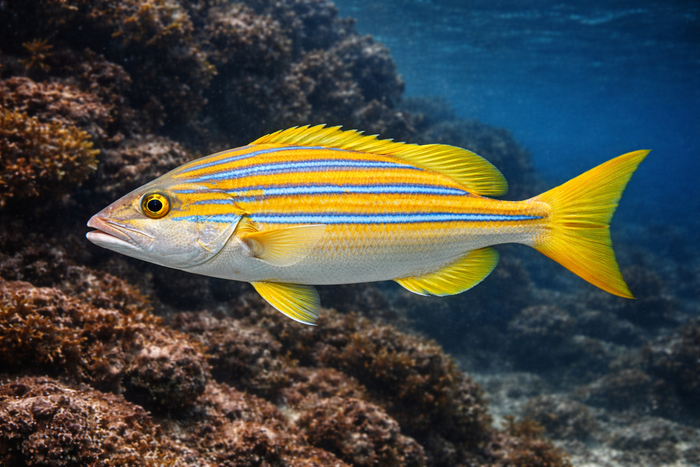
Mimic Blenny (Aspidontus taeniatus): The Master of Underwater Disguise and Deception
The Mimic Blenny isn’t just another reef fish blending into the background. It’s a cunning impersonator, a small marine Houdini that tricks its way through the coral chaos. Aspidontus taeniatus has carved a niche by mimicking the cleaner wrasse, fooling both predators and prey alike. This fish isn’t just a curiosity; it’s a fascinating study in evolutionary strategy and survival in the competitive reef environment.
What Makes the Mimic Blenny Unique?
The Mimic Blenny’s claim to fame is its uncanny resemblance to the cleaner wrasse, Labroides dimidiatus. Cleaner wrasses are the reef’s janitors, picking parasites off larger fish. The Mimic Blenny exploits this goodwill by copying the cleaner’s appearance and behavior—but with a twist. Instead of cleaning, it bites chunks of flesh or scales from unsuspecting fish. This aggressive mimicry is a rare and bold survival tactic.
Its slender body, striped pattern, and swimming style are near-perfect copies of the cleaner wrasse, fooling even the most vigilant reef residents. This deception allows the Mimic Blenny to approach potential prey without triggering alarm. Unlike many blennies that rely on camouflage or hiding, Aspidontus taeniatus uses trickery as its primary defense and hunting method.
Habitat & Global Range
Mimic Blennies are native to the Indo-Pacific region, spanning from the Red Sea and East Africa across to the central Pacific islands. They favor shallow coral reefs, typically in areas where cleaner wrasses are abundant. This overlap is no accident; the Mimic Blenny’s survival depends on the presence of its model species.
Mimic Blenny habitat usually consists of reef flats and lagoons with plenty of coral cover and crevices. These environments provide both hunting grounds and shelter. The fish thrives in warm, tropical waters where the reef ecosystem is vibrant and diverse. Its distribution highlights the importance of healthy coral reefs for maintaining complex interspecies relationships.
Behavior & Temperament
The Mimic Blenny’s behavior is a masterclass in deception. It mimics the cleaner wrasse’s distinctive swimming pattern and even its “dance” to convince other fish it’s a harmless cleaner. When a larger fish approaches, expecting a parasite removal, the Mimic Blenny strikes, biting off scales or fin tissue before darting away.
This aggressive mimicry requires precision timing and nerve. The Mimic Blenny walks a fine line between fooling its targets and provoking retaliation. It’s not a social fish; it tends to be solitary or found in small groups, especially where cleaner wrasses are common.
Despite its bold tactics, the Mimic Blenny is relatively small and vulnerable to larger predators. Its mimicry also serves as a defense mechanism, as many predators avoid cleaner wrasses to maintain their own health. By association, the Mimic Blenny gains a degree of protection.
Ecological Importance
At first glance, the Mimic Blenny might seem like a reef troublemaker, but it plays a subtle role in the ecosystem. Its mimicry highlights the complex evolutionary arms race between species on coral reefs. By imitating cleaner wrasses, it influences the behavior of other fish, shaping interactions and community dynamics.
The presence of Mimic Blennies can affect the trust dynamics between cleaner wrasses and client fish. If clients become wary of cleaners due to mimic attacks, it could disrupt the mutualistic cleaning relationships essential for reef health. This delicate balance underscores the Mimic Blenny’s indirect impact on reef ecology.
Moreover, the Mimic Blenny’s feeding habits contribute to the reef’s biological turnover. By nibbling on scales and fins, it participates in a form of parasitism that, while harmful to individual fish, is part of the natural checks and balances within the reef community.
Conservation & Environmental Pressures
Like many reef dwellers, the Mimic Blenny faces threats from habitat degradation. Coral reef decline due to climate change, pollution, and destructive fishing practices puts pressure on its habitat and survival. Since it depends on cleaner wrasses and healthy reef systems, any disruption to these components can have cascading effects.
The Mimic Blenny is not currently listed as endangered, but its reliance on specific reef conditions makes it vulnerable to environmental changes. Protecting coral reefs and maintaining biodiversity hotspots is critical for preserving this species and the intricate ecological interactions it represents.
The FishyAF Take
The Mimic Blenny is a standout example of nature’s creativity and cunning. It’s not just another pretty fish; it’s a living lesson in evolutionary strategy and survival through deception. For anyone fascinated by reef dynamics or evolutionary biology, Aspidontus taeniatus offers a compelling story of adaptation and ecological interplay.
Understanding Mimic Blenny facts and habitat is more than trivia—it’s a window into the complexity of coral reef ecosystems. This fish reminds us that survival isn’t always about brute strength or speed. Sometimes, it’s about looking the part and playing the game with style and precision. The Mimic Blenny doesn’t just live on the reef; it rewrites the rules of interaction, one clever impersonation at a time.